
A domain trademark conflict occurs when a domain name is identical or confusingly similar to a registered trademark, exposing the buyer to a UDRP complaint, a cease-and-desist letter, or federal litigation under the Anticybersquatting Consumer Protection Act (ACPA). Before you acquire any domain, you must run it through the USPTO’s TESS database, the Madrid Monitor for international marks, and a comprehensive common-law search covering unregistered brand usage. Skipping this step is the single most expensive mistake a domain buyer can make, since a conflict discovered after purchase can mean losing the domain, the money paid for it, and potentially the legal fees to defend a dispute.
Buying a domain feels simple: find a name you like, check availability, complete the purchase. But that simplicity hides a legal minefield that catches thousands of buyers every year. A domain that looks perfectly available on a registrar’s search bar can still belong – legally, if not technically – to a company that has spent years and millions of dollars building trademark rights around that exact word or phrase.


This is where a premium domain names for sale marketplace becomes valuable, since reputable platforms vet inventory more carefully than open registration pools, but the final responsibility for trademark clearance always rests with the buyer. Whether you’re acquiring a domain for a startup, an investment portfolio, or a client project, understanding how to check a domain trademark conflict is not optional due diligence – it’s the difference between owning an asset and inheriting a lawsuit.
In this guide, you’ll learn exactly how trademark conflicts happen, which databases and tools professional domain buyers rely on, how to interpret what you find, and what to do if your dream domain turns out to carry legal risk.
What is a Domain Trademark Conflict?
A domain trademark conflict exists whenever a domain name overlaps – exactly or confusingly – with a trademark that someone else has legally established rights to. This overlap can trigger a formal dispute even if you registered the domain in good faith and had no knowledge of the existing mark.
Trademark rights generally attach to a brand name, logo, slogan, or product name that is used in commerce to distinguish goods or services from competitors. In the United States,
these rights can arise in two ways:
- Registered trademarks, filed and approved through the USPTO (or equivalent bodies internationally)
- Common-law trademarks, established simply through consistent use in commerce, even without formal registration
Both types can form the basis of a legitimate challenge to your domain ownership. This is why a “clean” search of the USPTO database alone is not sufficient; it only tells half the story.

Featured Snippet Answer: What Counts as a Domain Trademark Conflict?
A domain qualifies as having a trademark conflict when it:
- Matches a registered trademark exactly, in the same or a related industry
- Is a common misspelling or “typosquat” of a well-known brand
- Combines a trademarked term with a generic word (e.g., “brandnamestore.com”)
- Uses a phonetically similar name likely to cause consumer confusion
- Was previously used by the trademark holder and later expired or lapsed
Why Trademark Conflicts Happen More Often Than You’d Think
Domain buyers often assume that if a name is available to register, it must be legally safe. That assumption is false, and it’s the root cause of most disputes. Registrars check only whether a string of characters is registered as a domain – they do not check trademark databases, industry usage, or brand history.
Consequently, a domain can be:
- Technically available through any registrar
- Completely unregistered as a domain before
- Still in active violation of someone else’s trademark rights
Additionally, trademark protection is often industry-specific. A word can be trademarked for software while remaining free for use in food service, apparel, or another unrelated category. This nuance trips up many buyers who see a trademark hit and assume it automatically disqualifies the domain, when in fact the classification (via the Nice Classification system) may not overlap with their intended use at all.

Common Scenarios That Trigger Disputes
- Cybersquatting: registering a domain in bad faith, intending to profit from a well-known brand’s reputation
- Typosquatting: registering common misspellings of popular trademarked brands
- Expired domain revival: purchasing a dropped domain that once belonged to a trademarked business, without realizing the mark is still active
- Coincidental overlap: independently choosing a name that, unbeknownst to you, matches an existing regional or niche trademark
Step-by-Step: How to Check a Domain for Trademark Conflicts
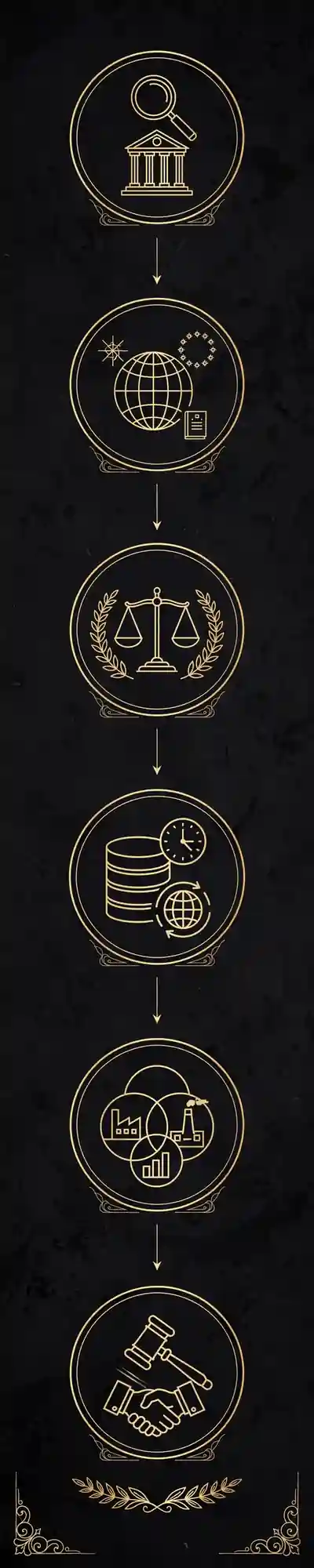
Professional domain buyers and brand consultants follow a layered research process rather than relying on a single search. Below is the sequence experienced buyers use before finalizing any enterprise domain acquisition.
Step 1: Search the USPTO Trademark Database (TESS)
Start with the United States Patent and Trademark Office’s Trademark Electronic Search System. This is the authoritative source for federally registered marks in the U.S.
- Use both exact-match and “sounds like” search modes
- Search the core term without extensions like “.com” or generic suffixes
- Note the trademark’s status (live, dead, abandoned, pending)
- Check the Nice Classification to see which industry the mark covers
Step 2: Check International Registries
If your domain will operate globally, or if you plan to sell into international markets, don’t stop at the USPTO. Review:
- WIPO’s Madrid Monitor for internationally registered marks
- EUIPO’s eSearch for European Union trademarks
- UKIPO for United Kingdom-specific registrations
- Country-specific trademark offices relevant to your target markets
Step 3: Run a Common-Law Trademark Search
Because unregistered trademarks can still carry legal weight, search beyond formal databases:
- Google the exact term along with quotation marks to find brand usage
- Check business directories, industry publications, and app stores
- Search social media handles and business listings under that name
- Review the Wayback Machine for historical use of the term as a business name
Step 4: Review the Domain’s Ownership and Usage History
A domain’s past matters as much as its present. Use WHOIS history tools and the Wayback Machine to see:
- Whether the domain previously belonged to a branded business
- If it was used for spam, adult content, or blacklisted activity
- Whether it has appeared in prior UDRP disputes (searchable via WIPO’s case database)
Step 5: Evaluate Industry and Geographic Overlap
A trademark hit doesn’t automatically mean “avoid.” Instead, assess:
- Does the trademarked business operate in the same industry you plan to enter?
- Is the mark registered nationally, regionally, or only in a specific state?
- Is the trademark “famous” enough to receive broader dilution protection, even outside its registered category?
Step 6: Consult a Trademark Attorney for Borderline Cases
If your research turns up ambiguous results, a licensed trademark attorney can run a comprehensive clearance search and issue a legal opinion. This is standard practice before any six- or seven-figure domain acquisition and is a worthwhile expense relative to the cost of a dispute.
Tools Professional Domain Buyers Use
| Tool | Purpose | Cost |
|---|---|---|
| USPTO TESS | Federal U.S. trademark search | Free |
| WIPO Madrid Monitor | International trademark search | Free |
| EUIPO eSearch Plus | European Union trademark search | Free |
| Trademarkia | Simplified search across multiple jurisdictions | Free (paid reports available) |
| WHOIS History (DomainTools, WhoisXML) | Past ownership and usage records | Paid |
| Wayback Machine | Historical website content | Free |
| WIPO UDRP Case Database | Past domain dispute rulings | Free |
| Trademark attorney clearance search | Legal-grade comprehensive review | Paid, case-dependent |
Comparison: DIY Search vs. Professional Trademark Clearance
| Factor | DIY Search | Professional Clearance |
|---|---|---|
| Cost | Free to low-cost | Typically $500-$2,500+ |
| Coverage | Registered marks, basic common-law | Registered, common-law, industry-specific, litigation history |
| Turnaround | Same day | 3-10 business days |
| Legal Opinion | None | Formal written opinion, usable as due diligence evidence |
| Best For | Low-value or personal domains | Six-figure acquisitions, brand launches, agency clients |
For domains that will anchor a serious brand, the professional route is worth the investment, especially when the purchase involves negotiating a premium domain price in the five- or six-figure range.
Common Mistakes Buyers Make When Checking for Trademark Conflicts
- Searching only the exact domain string, ignoring phonetic and visual variations
- Assuming a “.com” trademark search covers all extensions, when trademark rights are extension-agnostic
- Ignoring dead or abandoned trademarks, which can sometimes still carry common-law rights
- Overlooking international markets when the business plans to expand globally
- Not checking UDRP case history, missing a domain’s prior dispute record
- Confusing domain availability with legal clearance – these are entirely separate concepts
- Skipping industry classification review, wrongly assuming any trademark match is disqualifying

Expert Tips for Reducing Trademark Risk
- Favor coined or invented terms (like many premium brandable names) over descriptive, dictionary-based phrases, since invented words are inherently easier to trademark and defend
- When evaluating domain names for a startup, run your shortlist through TESS before falling in love with any single option
- Document your search process and results; this record can demonstrate good faith if a dispute ever arises
- Consider filing your own trademark application soon after acquiring a domain intended for long-term brand use, since registration strengthens your legal position
- If a trademark hit exists but the industry is unrelated, retain written notes on the classification difference in case the question resurfaces later
- Remember that domain name and brand trust depend on more than legal clearance alone; a legally clean name should also fit your positioning and audience
Understanding Trademark Classes: Why Industry Overlap Matters
Trademark protection isn’t universal across every product or service category. Under the international Nice Classification system, trademarks are registered within one or more of 45 distinct classes, ranging from software and financial services to clothing, food, and household goods. This structure exists precisely so that unrelated businesses can share similar names without automatically infringing on each other.
For example, a company that holds a trademark for “Atlas” in Class 9 (computer software) generally cannot block a completely unrelated business from using “Atlas” in Class 25 (clothing), unless the mark is considered “famous” and therefore eligible for broader dilution protection under trademark law. This is why a raw trademark search result can be misleading if read without context – a single hit doesn’t automatically mean the domain is off-limits.

When you check a domain trademark conflict, always cross-reference:
- The exact class number(s) listed on the trademark registration
- Whether your intended use falls within that class or a closely related one
- Whether the mark has “incontestable” status, which strengthens the owner’s legal position
- Whether the mark qualifies as “famous,” a status reserved for widely recognized brands that receive protection across all classes, not just their registered category
This step alone prevents the common mistake of walking away from a perfectly usable domain simply because a search tool returned a partial match in an unrelated field.
How to Read a Trademark Record
Once you locate a potential match in TESS or another database, look for these key data points before drawing conclusions:
- Mark type: word mark, design mark, or combination mark
- Filing basis: actual use in commerce versus intent-to-use
- Status: live, registered, pending, abandoned, or cancelled
- Owner information: individual, small business, or large corporation (larger, well-funded owners are statistically more likely to pursue enforcement)
- First use date: this establishes priority, which matters heavily in common-law disputes
Real-World Patterns Behind Domain Trademark Disputes

While every case is unique, professional domain buyers and brand consultants see recurring patterns in how trademark disputes unfold. Recognizing these patterns helps you evaluate risk more accurately than a single database search ever could.
- Category-crossing brand expansion: A company trademarked in one industry expands into e-commerce or software and later challenges a domain owner who registered a matching name years earlier for an unrelated purpose. Courts and UDRP panels weigh the original registrant’s intent heavily in these cases.
- Post-acquisition rebranding: A startup acquires a short, brandable domain, later discovers a regional trademark conflict during its own trademark filing process, and must renegotiate or rebrand entirely.
- Portfolio investors caught by surprise: Domain investors holding large portfolios sometimes overlook a conflict buried in a bulk purchase, only surfacing the issue when a resale buyer’s legal team flags it during due diligence.
- Good-faith registrants prevailing: In several documented UDRP rulings, panels have sided with domain owners who could show the name was registered for its generic, descriptive, or brandable value rather than to exploit an existing trademark – reinforcing why documentation of your intent and search process matters.
These patterns illustrate a consistent theme: the domain buyers who avoid disputes are the ones who research thoroughly, document their process, and understand the difference between coincidental overlap and deliberate infringement.
How Reputable Domain Marketplaces Reduce Trademark Risk
Not all domain sources carry equal risk. Open, unmoderated marketplaces and expired-domain auctions can surface names with murky histories, prior UDRP rulings, or lingering brand associations. Working with a curated marketplace adds a layer of protection, though it never fully replaces buyer-side due diligence.

When comparing where to source a domain, consider:
- Whether the platform screens for prior UDRP or ACPA history before listing
- Whether ownership history and WHOIS records are transparently available
- Whether the marketplace provides support during negotiation and transfer, reducing the chance of disputes arising from unclear provenance
- How the platform’s process compares to alternatives, such as what you’d find when weighing Afternic vs. Sedo vs. Dan vs. Atom for sourcing premium inventory
A well-managed marketplace won’t guarantee zero trademark risk, since new trademark filings happen daily, but it significantly reduces the odds of buying a domain with an active, documented history of disputes.
Pre-Purchase Checklist: Confirming a Domain is Trademark-Safe

Before finalizing any domain purchase, run through this checklist:
- Searched the exact term in USPTO TESS, noting status and class
- Checked WIPO Madrid Monitor for international registrations
- Reviewed common-law usage through search engines and business directories
- Pulled WHOIS history to confirm past ownership and usage
- Checked the Wayback Machine for historical website content
- Searched the WIPO UDRP case database for prior disputes involving the domain
- Evaluated industry classification overlap with any trademark hits
- Documented every step of the search process, with screenshots or saved records
- Consulted a trademark attorney if the purchase price or brand stakes are significant
- Confirmed the domain’s appraisal factors align with a legitimate valuation, not merely proximity to a well-known brand
Treat this checklist as a minimum baseline, not a substitute for professional legal advice on higher-stakes acquisitions.
What Happens If You Buy a Domain With a Trademark Conflict?

If a trademark holder identifies a conflict after your purchase, they typically pursue one or more of these paths:
- Cease-and-desist letter – a formal request to stop using or transfer the domain
- UDRP complaint – an arbitration process through ICANN-approved providers like WIPO or the Forum, often resolved within 60 days
- ACPA lawsuit – a federal court claim under the Anticybersquatting Consumer Protection Act, which can result in statutory damages up to $100,000 per domain in bad-faith cases
- Trademark infringement lawsuit – broader litigation if the domain is actively used in a way that causes consumer confusion
The outcome of a UDRP proceeding hinges on three factors the complainant must prove: the domain is identical or confusingly similar to their mark, the registrant has no legitimate rights to the name, and the domain was registered and used in bad faith. Buyers who can show a legitimate business purpose and a documented trademark clearance search are in a far stronger position to defend their registration.
Trademark Risk by Domain Type: A Quick Reference

Not every category of domain carries the same level of trademark exposure. Understanding where your target name falls on this spectrum helps you calibrate how much research is truly necessary.
- Generic/dictionary-word domains (e.g., “bestcoffee.com”): Lowest risk, since generic terms are difficult to trademark exclusively, though combinations with a specific brand name still warrant a check.
- Coined or invented brandable domains (e.g., short, unique names created for branding purposes): Moderate risk if the term coincidentally matches an existing mark, but generally the safest category to build a defensible brand around once cleared.
- Acronym or initialism domains: Moderate-to-high risk, since acronyms are frequently trademarked across multiple unrelated industries simultaneously.
- Domains matching well-known consumer brands: Highest risk, particularly if the brand is globally recognized, since famous marks receive dilution protection extending beyond their registered category.
- Geo-plus-industry domains (e.g., “cityname-service.com”): Generally lower risk but still worth checking against regional or local trademarks, which are easy to miss in a national-only search.
Buyers assembling a portfolio, whether for domain investing or for a single startup brand, benefit from applying this risk lens to every shortlist before spending time on deeper legal research.
How Long Should a Trademark Clearance Search Take?

For a single domain intended for personal or small business use, a thorough self-guided search across TESS, common-law sources, and WHOIS history typically takes between 30 and 90 minutes. For higher-value acquisitions, or when building a shortlist of multiple candidate names, budget closer to a half-day per name if you’re conducting the research yourself.
Professional clearance searches, handled by a trademark attorney or specialized search firm, generally return results within three to ten business days, depending on how many jurisdictions are included in the scope. For international brand launches spanning multiple countries, this timeline can extend further, since each additional jurisdiction requires its own database review and, in some cases, a local counsel opinion.
Building this research time into your acquisition timeline – rather than treating it as an afterthought right before closing – gives you room to walk away from a risky name without the pressure of a looming deadline influencing your decision.