
Domain name brand trust is the silent credibility signal that forms in a buyer’s mind within milliseconds of reading a URL, long before any product page, testimonial, or price point enters the picture. A domain functions as a pre-cognitive trust filter: short, brandable, keyword-relevant names trigger associations with legitimacy and permanence, while awkward, hyphenated, or numeral-heavy strings trigger associations with risk and impermanence. This isn’t a marketing opinion; it’s a pattern rooted in how the human brain processes unfamiliar written information under time pressure.
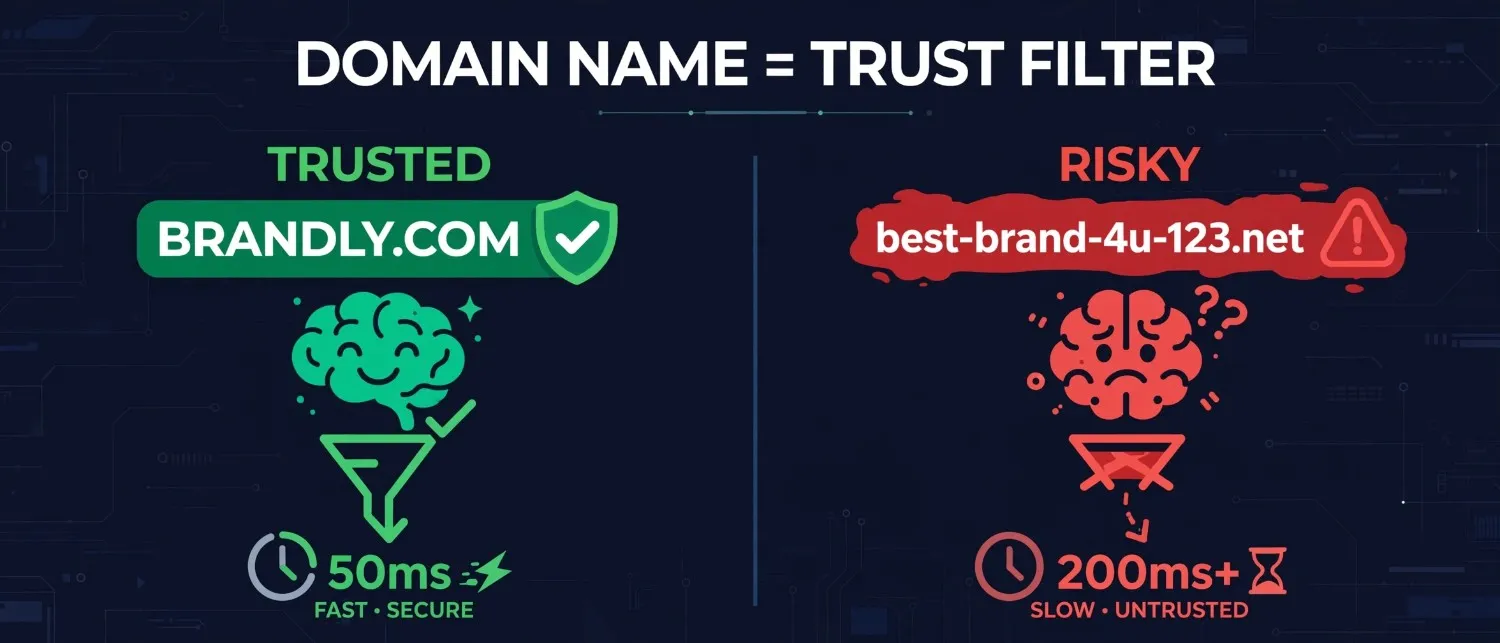
For companies acquiring premium domain names for sale as part of a long-term brand strategy, this single decision often carries more weight on first-time conversion rates than the homepage design that sits behind it.
Quick Answer: Domain name brand trust is the instant, subconscious credibility judgment a visitor forms about a business based entirely on the readability, length, and structure of its web address, before the homepage, product, or pricing has been seen. Businesses that ignore this signal often lose a portion of their traffic before their actual value proposition ever gets a fair evaluation.
What “Domain Name Brand Trust” Actually Means
Domain name brand trust refers to the degree of credibility, professionalism, and legitimacy a visitor unconsciously assigns to a business based solely on its web address. It is a distinct concept from general brand trust, which builds over months or years through repeated positive experiences. Domain-level trust, in contrast, is formed instantly and shapes whether a visitor even gives the business a chance to earn that longer-term trust at all.
In short:
Quick definition
Domain name brand trust is the instant credibility judgment a visitor makes about a company based on the structure, clarity, and memorability of its domain name.
Why it matters
It acts as a gatekeeper. If the domain fails the trust test, many visitors never scroll past the first section of the homepage.
Where it applies
E-commerce, SaaS, professional services, healthcare, finance, and any sector where a first-time visitor has no prior brand recognition to fall back on.
Why Trust Forms Before the Homepage Loads
Every click on a search result, ad, or shared link exposes the domain name before any other brand asset. Consequently, the domain is processed first, and first impressions carry disproportionate psychological weight.
Consider the typical decision sequence for a cold visitor:
- They see the domain in a search result, browser tab, or email signature.
- They form a snap judgment about legitimacy, often in under a second.
- Only after that judgment do they engage with the actual page content.
If step two produces doubt, steps three and beyond happen with a skeptical lens already applied, if they happen at all. This sequencing is precisely why brand-conscious businesses increasingly treat the domain acquisition process with the same seriousness as logo design or brand messaging, rather than as an afterthought handled at the last minute during a website build.
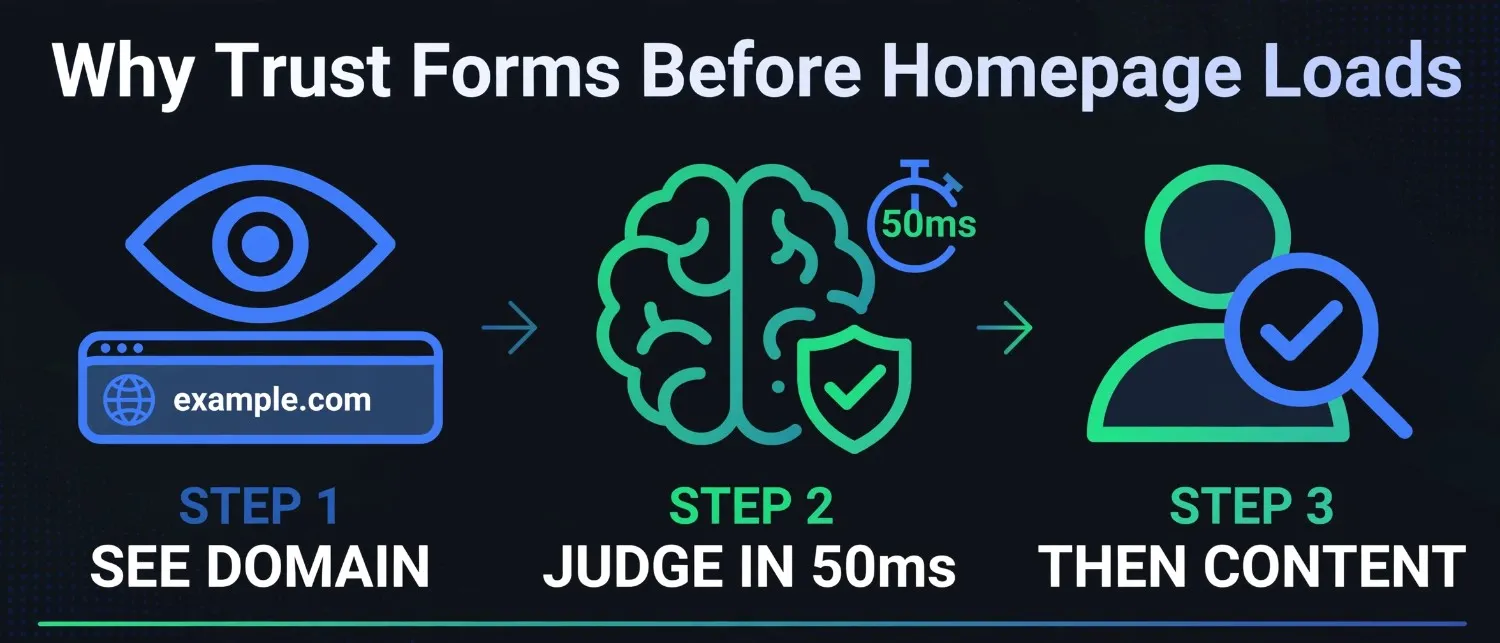
Independent research backs up how narrow this window really is. Google’s own design research team has documented that people begin forming an aesthetic opinion about a webpage within roughly 17 to 50 milliseconds of first exposure, a window so short that no amount of homepage copywriting can intervene before the judgment has already started forming, according to Google’s research on first impressions. Separate long-running research from the Nielsen Norman Group on trustworthy web design similarly found that visitors size up legitimacy through surface-level cues long before they read a single sentence of body copy, which places the domain name, arguably the most surface-level cue of all, at the very front of that evaluation chain.
Why This Matters More for Cold Traffic Than Repeat Visitors
Returning customers already carry accumulated trust from prior positive experiences, so a slightly awkward domain barely registers with them. Cold traffic, however, arrives with zero context. Paid search visitors, cold email recipients, and first-time referral clicks are all evaluating the domain in isolation, with no prior relationship to soften the judgment. This is why domain-level trust matters disproportionately for growth-stage businesses that depend heavily on acquiring new customers rather than nurturing an existing base.
The Psychology Behind Domain-Level First Impressions
Several overlapping psychological mechanisms explain why a domain name carries so much persuasive weight before any product is even visible.
Processing Fluency
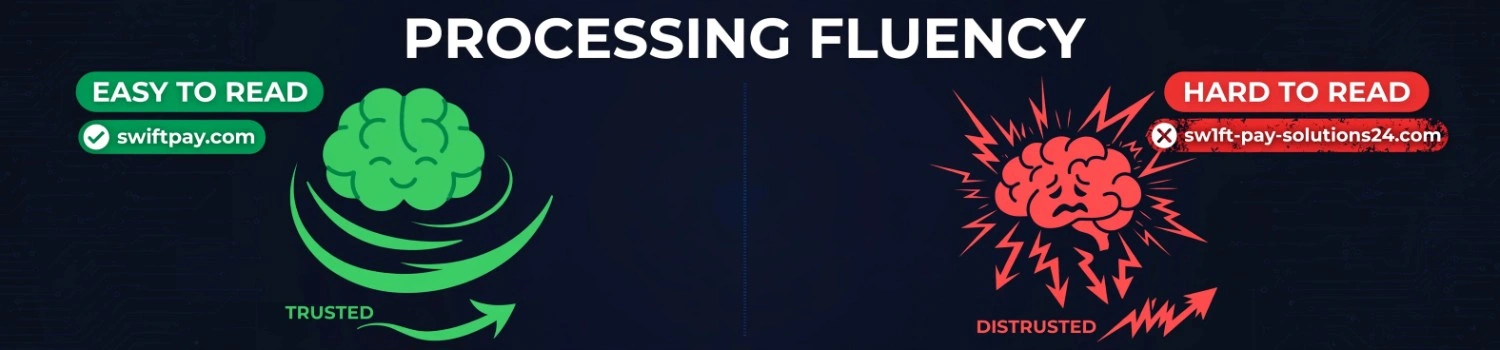
Cognitive psychology research consistently shows that information which is easier to read and pronounce is judged as more trustworthy and more true, a phenomenon researchers call the fluency effect. A domain such as swiftpay.com is processed effortlessly, while sw1ft-pay-solutions24.com forces the brain to work harder, and that extra effort gets misattributed as suspicion rather than simple unfamiliarity.
Heuristic Shortcuts Under Time Pressure
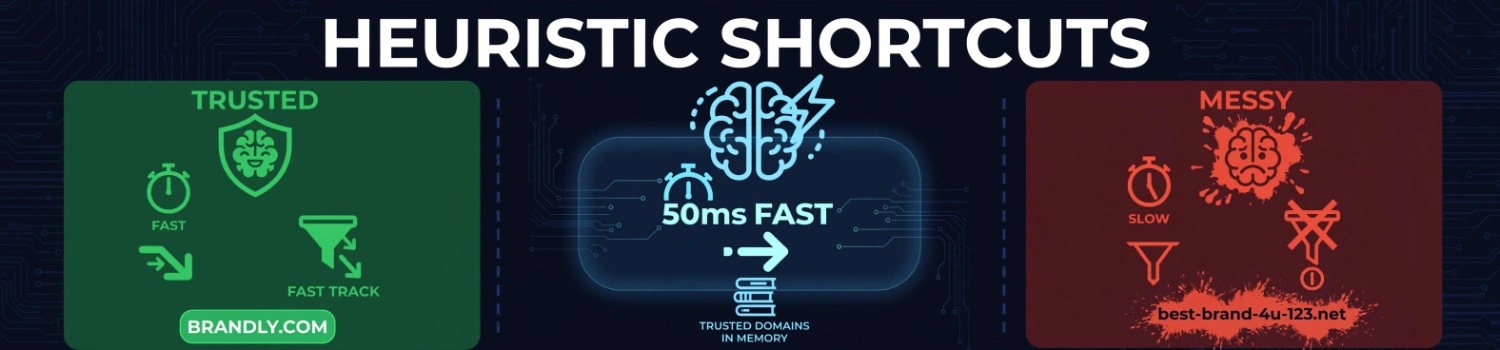
Visitors rarely evaluate a domain analytically. Instead, they rely on mental shortcuts, or heuristics, that compare the new domain against a mental library of domains they already know and trust. Short, dictionary-based, or brandable names fit that library more comfortably than long or symbol-heavy alternatives.
Association With Legitimacy Signals
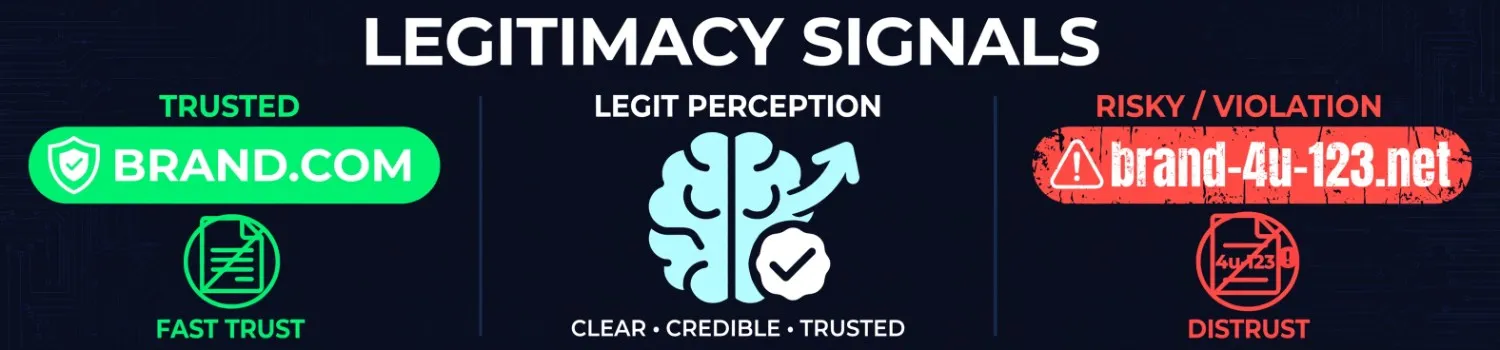
Certain domain characteristics have become culturally linked with legitimacy over the past two decades of internet use: a clean .com extension, absence of numbers substituting for letters, and alignment between the domain and the actual business name or category. When a domain violates these learned patterns, it triggers a subtle risk-avoidance response, even if the visitor can’t articulate exactly why.
The Halo Effect and Domain Perception
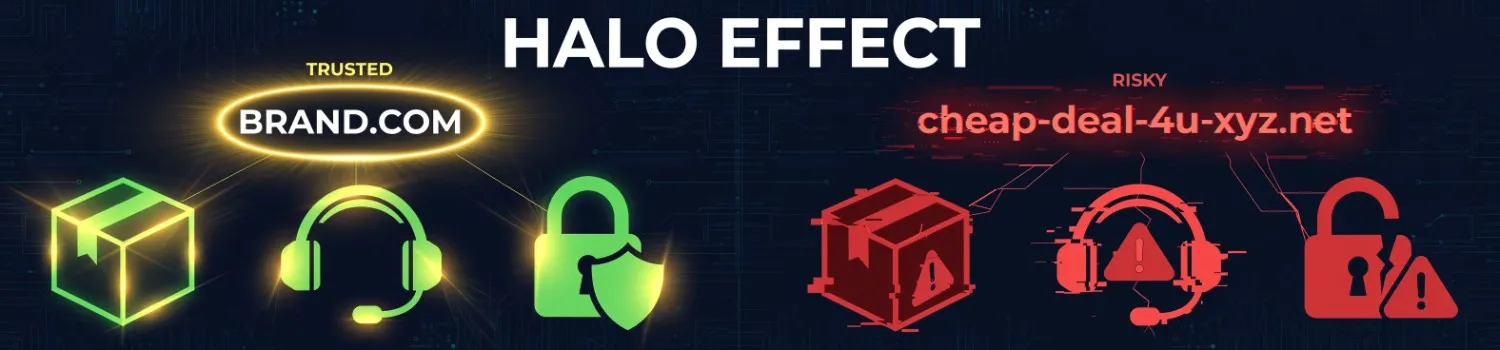
Psychologists describe the halo effect as the tendency for a single positive trait to color the perception of everything else about a subject. Applied to domains, a name that reads as polished and intentional creates a halo that extends to the perceived quality of the product, the responsiveness of customer support, and even the security of the checkout process, none of which the visitor has actually verified yet. The inverse is equally true: a domain that reads as careless creates a “horn effect,” where a single negative impression taints every subsequent judgment, making it harder for genuinely strong product pages or testimonials to recover the visitor’s confidence.
Loss Aversion and Perceived Risk
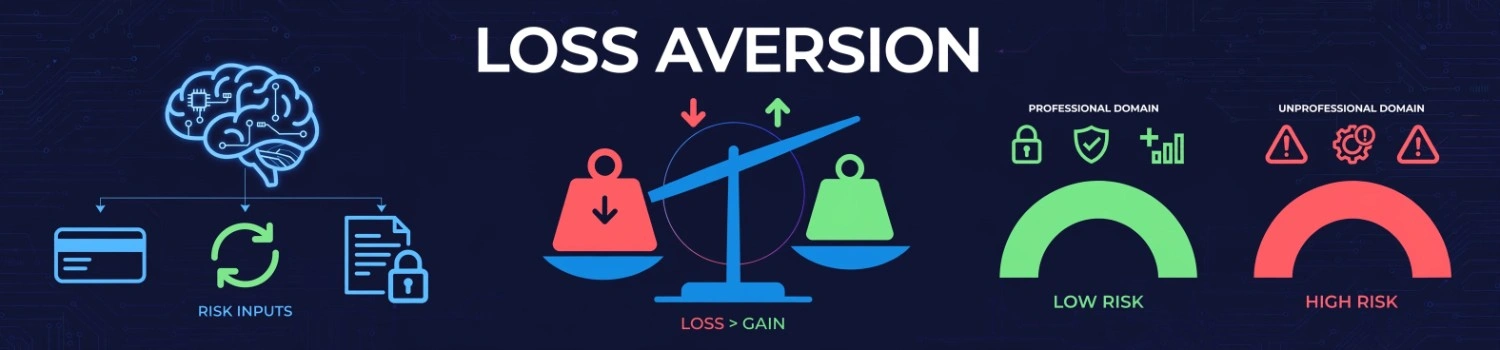
Behavioral economics research consistently shows that people weigh potential losses more heavily than equivalent potential gains. When a visitor lands on an unfamiliar domain, especially one involved in a transaction, a subscription, or a data entry form, the brain runs a rapid risk calculation. A domain that feels unprofessional amplifies perceived risk, which raises the bar a business must clear before a visitor is willing to proceed. This is particularly relevant for finance, healthcare, and B2B software categories, where the cost of a bad decision feels higher to the visitor than it might in a low-stakes retail purchase.
Domain Characteristics That Build or Break Trust
Not every domain trait carries equal psychological weight. Below is a breakdown of the factors that most consistently influence buyer perception.
Factors that build trust:
- Short length, generally under 15 characters
- A recognizable
.comextension - Easy pronunciation and spelling, even for non-native speakers
- Semantic relevance to the industry or offering
- Absence of hyphens, numbers, or unusual symbols
Factors that erode trust:
- Excessive length or compound phrases stitched together
- Numerals replacing letters (e.g., “4” for “for”)
- Hyphens, which visitors often associate with expired or spam-adjacent domains
- Unfamiliar or novelty extensions used in industries where
.comis the norm - Names that sound generic, templated, or interchangeable with dozens of competitors
Trust Signal Comparison Table
| Domain Trait | Buyer Perception | Trust Impact | Common Use Case |
|---|---|---|---|
| Short, brandable .com | Established, professional | High | Flagship company sites |
| Hyphenated multi-word domain | Budget, possibly spam-adjacent | Low | Low-cost temporary sites |
| Numeral-substituted domain | Confusing, less credible | Low to Medium | SEO-driven landing pages |
| Industry-relevant keyword domain | Clear, purpose-built | High | Niche service providers |
| Long descriptive phrase domain | Overly literal, less premium | Medium | Informational blogs |
| Novelty extension (in a .com-dominant field) | Uncertain legitimacy | Low to Medium | Startups, side projects |
Domain Trust and SEO: Why Google Cares Too
Domain name brand trust isn’t purely a human psychology issue; search engines factor in similar signals when evaluating a site’s overall quality. Google’s own URL structure best practices documentation recommends simple, descriptive, human-readable structures over complex or cluttered alternatives, the same underlying principle that drives human trust judgments. A clean, well-chosen root domain gives every subsequent URL on the site a stronger foundation, since descriptive, uncluttered paths are easier for both crawlers and visitors to parse.
This overlap matters for two reasons:
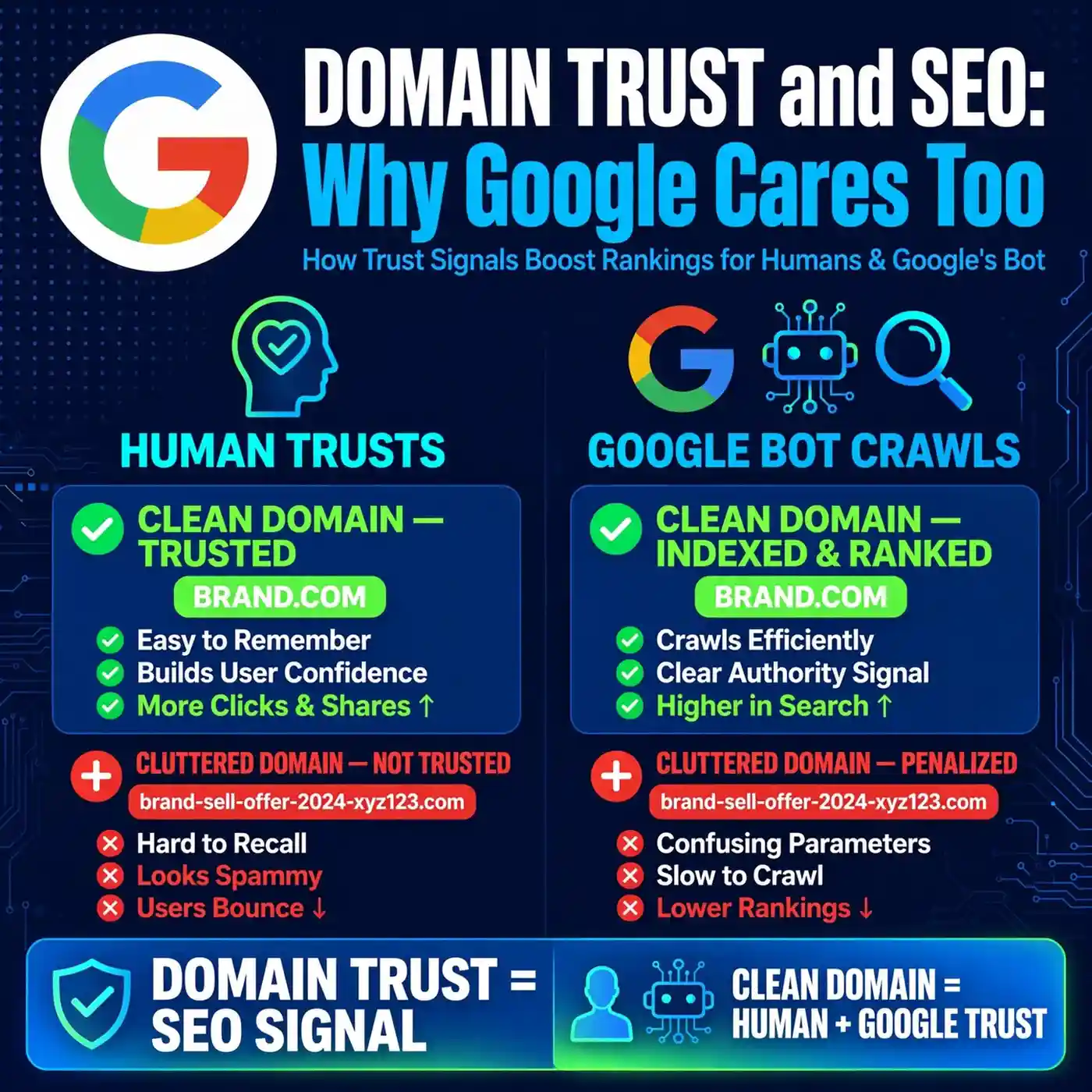
Search engines increasingly reward the same clarity that visitors respond to.
A confusing domain doesn’t just cost trust with humans; it can add friction to how efficiently a site’s content gets crawled and understood.
Brand search volume compounds over time.
A memorable, trust-building domain is dramatically more likely to be typed directly into a browser or recalled in a branded search query, both of which are signals that reinforce long-term visibility.
Common Domain Mistakes That Quietly Destroy Buyer Confidence
Even experienced founders make avoidable domain decisions that undercut the very trust they’re trying to build elsewhere in their brand strategy.
Choosing a name for SEO first, brand second.
Stuffing a domain with keywords might have helped rankings a decade ago, but today it reads as inauthentic and reduces perceived credibility. Modern search algorithms weigh people-first quality signals far more heavily than exact-match domain strings, which means the SEO upside of keyword-stuffing has shrunk dramatically while the trust cost has stayed just as high.
Settling for a hyphenated version because the clean name was taken.
A hyphen is rarely a neutral compromise; it actively signals “second choice” to a visitor who has seen the pattern before. Many visitors have also learned, sometimes the hard way, that hyphenated variants are occasionally used to mimic a more established brand, which adds a layer of suspicion that a clean name never has to overcome.
Ignoring pronunciation testing.
If a name can’t be said aloud confidently in a sales call, a podcast mention, or a radio ad, it will quietly undermine word-of-mouth growth. A prospect who can’t spell what they heard often defaults to a search engine query instead of typing the domain directly, adding friction, and sometimes routing that prospect straight to a competitor’s listing.
Overlooking domain history.
Acquiring a domain with a spammy or unrelated past can carry residual reputational baggage, even after a rebrand. This is one of the reasons professional due diligence on a domain’s backlink profile and prior usage matters just as much as its surface-level appeal.
Treating the domain as a placeholder to “fix later.”
Migrating domains after a brand has gained traction is costly, disruptive to SEO equity, and confusing to returning customers who may not follow the switch, some of whom will simply assume the original business closed down.
Prioritizing novelty over recognition.
Unusual spellings, invented words with silent letters, or intentionally quirky misspellings might stand out in a branding workshop, but they routinely fail the “tell a friend” test: if someone can’t repeat the domain accurately after hearing it once, referral traffic suffers.
Underestimating international readability.
A domain that works well for one language or market can create confusion, or even carry an unintended meaning, in another. Businesses with global ambitions benefit from stress-testing a shortlist across the markets they plan to serve.
How Premium Domains Compound Brand Trust Over Time
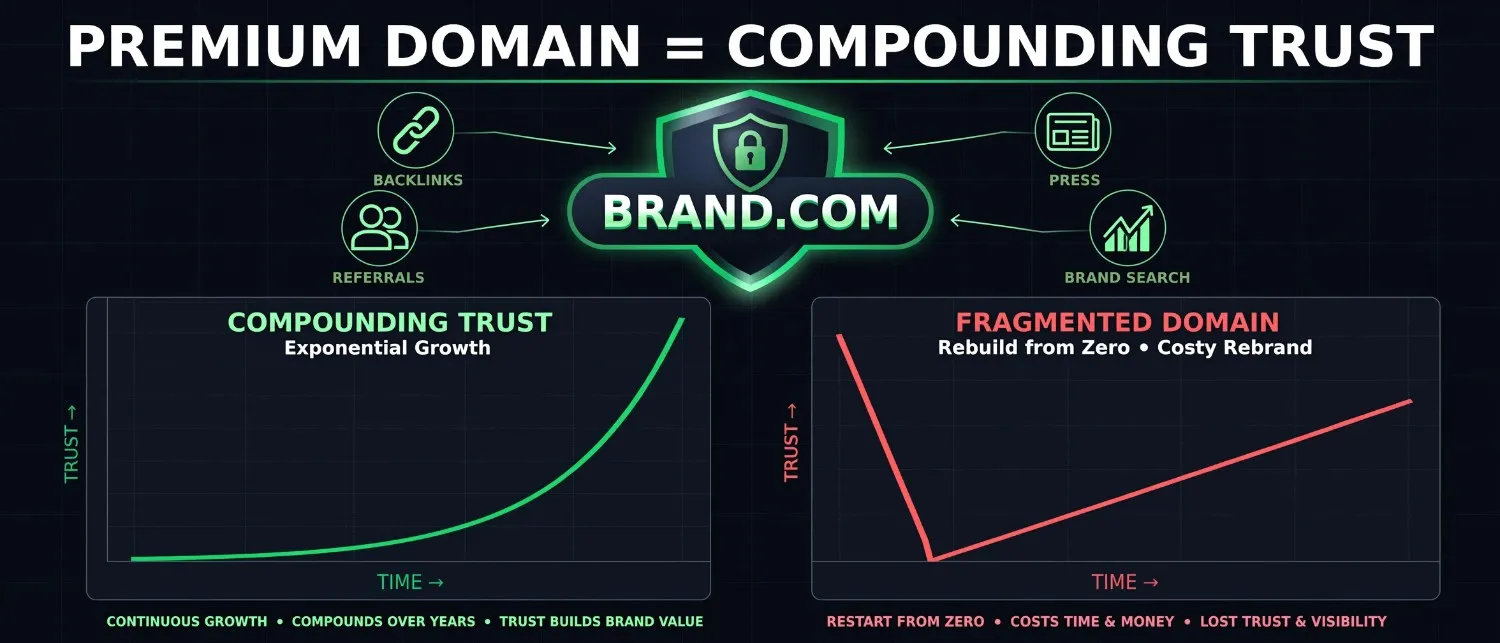
A well-chosen domain doesn’t just create a strong first impression; it compounds in value as the brand grows. Every backlink, every piece of press coverage, every customer referral reinforces trust in that specific string of characters. Businesses that start with a fragmented or forgettable domain often find themselves rebuilding this equity from zero after a rebrand, an expensive and risky undertaking that resource-rich brands go to great lengths to avoid.
This is part of why secondary-market acquisition of established, brandable domains has become a standard part of serious go-to-market planning, rather than a niche investor activity. Founders increasingly research what separates a smart domain acquisition from a wasted budget before committing capital, precisely because the wrong choice compounds negatively in the same way the right one compounds positively.
A Practical Illustration
Picture two competing SaaS companies launching in the same quarter with comparable products and comparable ad budgets. One operates on a short, brandable .com; the other launches on a hyphenated, four-word domain because the ideal name wasn’t available. Over 12 months of running near-identical paid acquisition campaigns, the company with the stronger domain typically sees higher landing page engagement and a lower cost per qualified lead, simply because fewer visitors bounce at the trust-evaluation stage before ever reaching the value proposition. Neither company’s product quality changed; the domain alone shifted how much of their traffic converted into a fair hearing.
This is precisely the gap that premium domain acquisition is designed to close. Rather than spending years building brand recognition around a compromised name, a business can acquire a name that already carries the structural traits associated with legitimacy from day one, effectively buying back the time it would otherwise take to earn that trust organically.
Step-by-Step: Auditing Your Domain for Trust Signals
Use this sequence to evaluate whether your current or prospective domain supports the level of buyer trust your business needs.
- Read it aloud to someone unfamiliar with your brand and ask them to spell it back without seeing it written.
- Check length and structure against competitors already trusted in your space.
- Search the domain’s history to confirm it hasn’t carried a reputation-damaging past.
- Test it in context, such as in an email signature, a business card, or a search engine results snippet.
- Compare it against your closest three competitors’ domains to see whether it reads as equally, more, or less credible.
- Get a professional valuation if you’re purchasing on the secondary market, since the criteria professional appraisers actually weigh often differ from what founders assume matters most.
Expert Tips for Choosing a Trust-First Domain Name
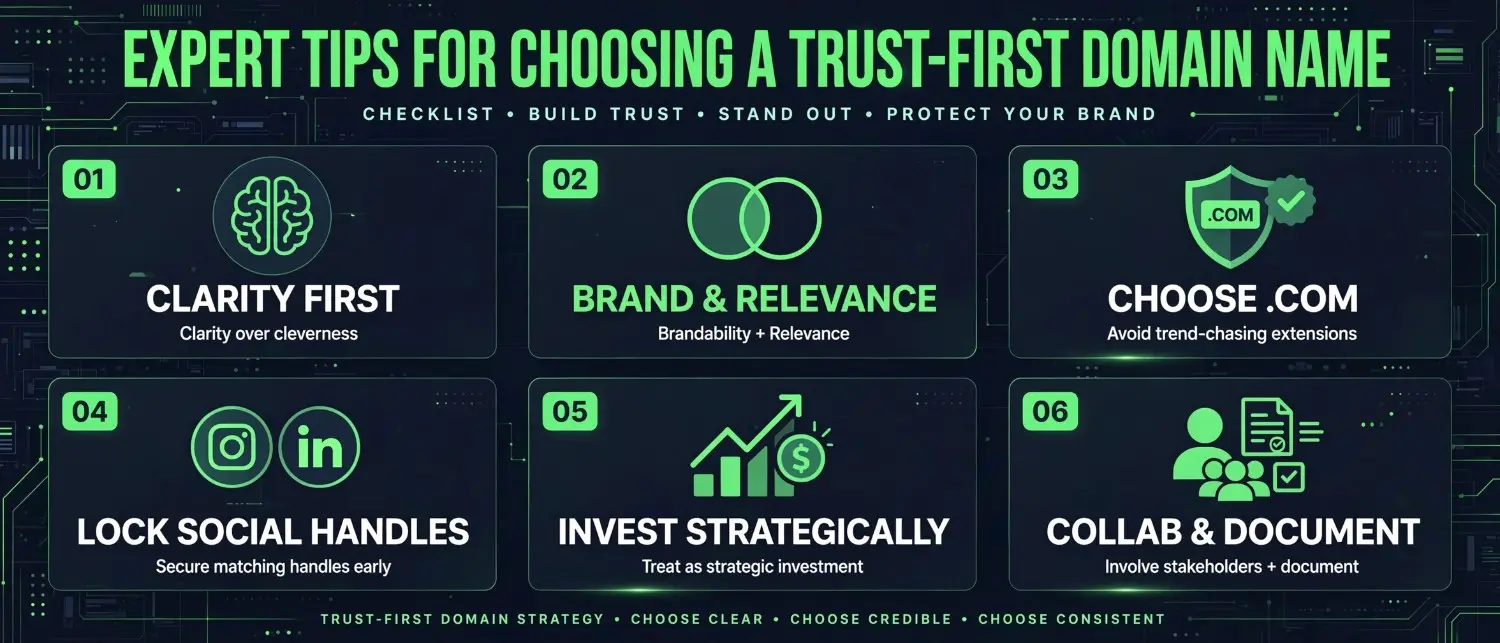
Prioritize clarity over cleverness.
A name that requires explanation is a name that loses casual visitors. If a domain needs a tagline just to make sense, it’s working against the brand rather than for it.
Favor brandability alongside relevance.
The strongest domains sit at the intersection of memorable and descriptive, rather than leaning entirely on one or the other. Purely descriptive names can feel generic, while purely invented names can feel unfamiliar; the sweet spot borrows enough recognizability from real language to stay intuitive.
Avoid trend-chasing extensions.
You should avoid buying trend-chasing extensions unless your industry has already normalized them. What feels fresh in one naming cycle can feel dated or off-brand within a few years, while .com has remained the default expectation across nearly every mainstream category.
Secure matching social handles early
First, we should try to ensure social profile usernames, so that cross-platform consistency reinforces the same trust signal everywhere a prospect encounters the brand, from a search result to an Instagram bio to a LinkedIn company page.
Treat domain acquisition as a strategic investment
The domain acquisition we should treat as a strategic investment, not a line-item expense, particularly for businesses planning a multi-year growth trajectory. The cost of a strong domain is typically a fraction of a single quarter’s paid acquisition budget, yet its trust dividend compounds across every campaign that follows.
Involve more than one stakeholder in the decision.
Founders are often too close to a name to judge it the way a cold visitor will; a quick gut-check from someone outside the business frequently surfaces readability or pronunciation issues that internal teams have stopped noticing.
Document the reasoning behind the final choice.
Recording why a domain was selected, and which alternatives were rejected, gives future marketing and brand teams a shared reference point instead of relitigating the decision every time leadership changes.
Industry Comparison: Legacy Naming vs. Premium Naming
| Approach | Typical Cost | Time to Establish Trust | Long-Term Brand Risk |
|---|---|---|---|
| Legacy/DIY naming (available cheap domain, hyphens, or extensions) | Low upfront | Slow, often 12+ months | High, frequent rebrand risk |
| Premium secondary-market acquisition | Higher upfront | Fast, often immediate | Low, durable brand asset |
How Domain Trust Requirements Shift by Industry
Not every industry weighs domain name brand trust the same way, and understanding where a business sits on that spectrum helps calibrate how much scrutiny the naming decision deserves.
Finance and fintech
Visitors are actively primed to look for fraud indicators, so a domain that feels even slightly off can trigger disproportionate hesitation before any security badge or compliance disclosure gets a chance to reassure them.
Healthcare and wellness
Trust here is tied to perceived authority and safety; a domain that reads as unofficial or overly promotional can undercut otherwise credible medical or clinical content.
B2B software and services
Buyers frequently forward a domain internally to colleagues or decision-makers before a purchase conversation even happens, so the domain has to hold up to scrutiny from people who never saw the original ad or search result.
E-commerce and retail
Trust intersects directly with willingness to enter payment information, making domain-level confidence a direct lever on cart completion rates.
Professional and legal services
Clients are often evaluating multiple providers side by side, and a domain that feels less established can quietly tip a close decision toward a competitor with a stronger name.
Across every one of these categories, the underlying mechanism is identical: the domain sets the tone for how skeptically, or how openly, everything that follows will be received.
FAQs About Domain Name Brand Trust
1. What is domain name brand trust?
Domain name brand trust is the instant credibility judgment a visitor forms about a business based purely on the structure and readability of its web address, before any other brand element is seen.
2. Does a domain name really affect conversion rates?
Yes. Because the domain is often the very first brand touchpoint, a domain that feels unprofessional or confusing can cause visitors to disengage before they ever reach a product page, directly suppressing conversion rates.
3. Are hyphenated domains bad for brand trust?
Generally, yes. Hyphenated domains are frequently associated with budget or SEO-driven sites rather than established brands, which subtly lowers perceived legitimacy.
4. Is a .com extension still important for trust?
In most industries, yes. .com remains the extension visitors subconsciously associate with established, legitimate businesses, even as alternative extensions have grown more common.
5. Can a business fix low domain trust without changing domains?
Some trust can be rebuilt through consistent branding, security certificates, and strong content, but the underlying domain structure itself continues to work against those efforts rather than for them.
6. When should a business consider buying a premium domain?
Ideally before significant marketing spend begins, since every dollar spent driving traffic to a low-trust domain underperforms relative to the same spend directed at a high-trust one.
Conclusion
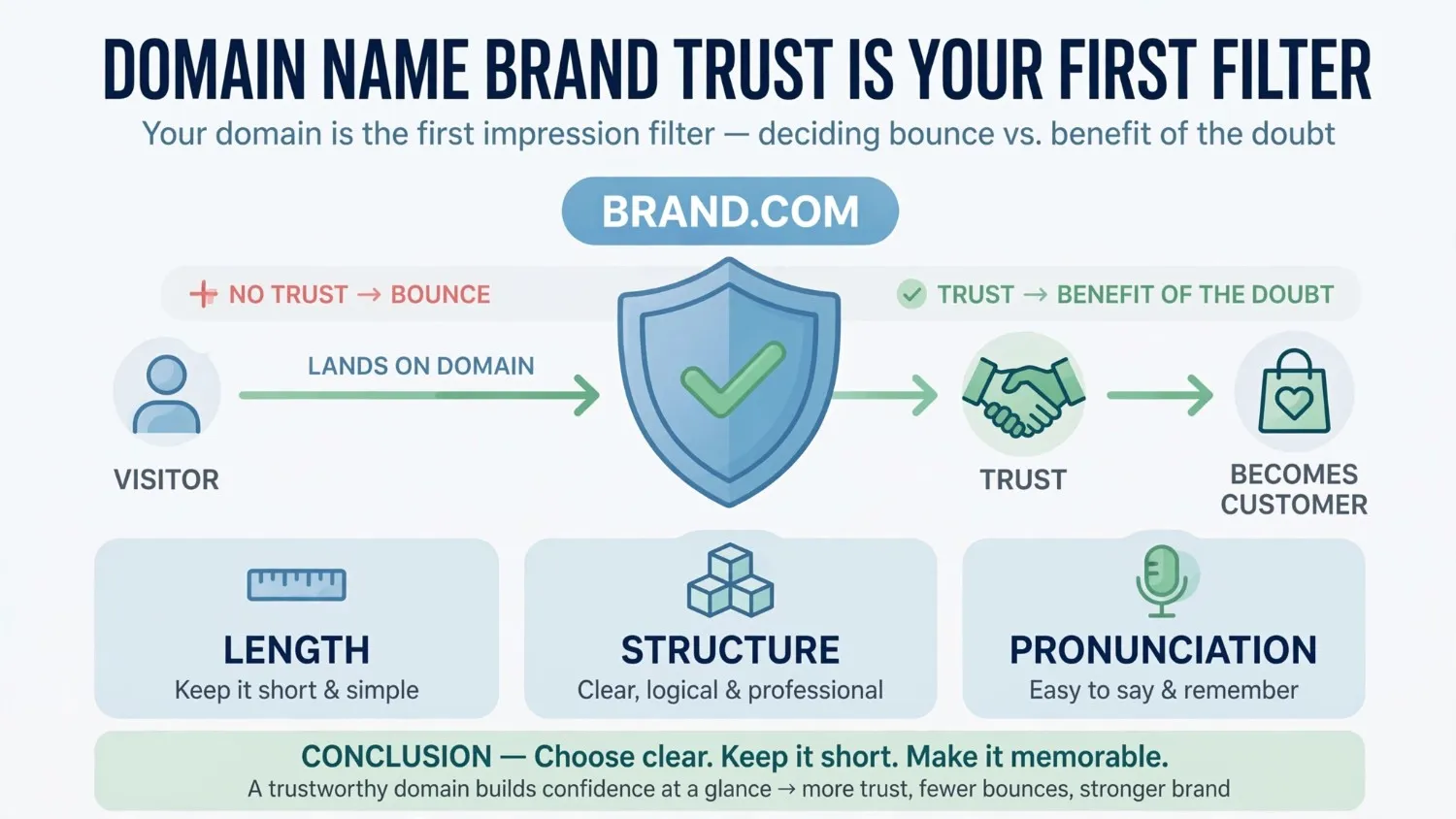
Domain name brand trust is not a soft, unmeasurable concept reserved for branding theorists; it is a concrete, first-impression filter that determines whether a visitor gives a business the benefit of the doubt or bounces before reading a single headline. Every characteristic of a domain, from length to structure to pronunciation, feeds into that split-second judgment. Businesses serious about converting cold traffic into paying customers can’t treat this decision as an afterthought.
If your current domain is working against the trust you’re trying to build, it’s worth exploring that are structured to earn buyer confidence from the very first impression.