
A sound startup domain name strategy weighs brandability, extension credibility, trademark exposure, and search visibility before a single dollar changes hands. The domain you register on day one becomes the anchor of your brand equity, your paid acquisition costs, and your investor due diligence file for years afterward. Get the fundamentals wrong, and you inherit a rebrand bill that dwarfs whatever you saved by skipping this step.
Founders rarely think about domain names as infrastructure. They think about them as an afternoon task squeezed between incorporating the company and designing a logo. That framing is exactly what causes regret. A domain is not a placeholder; it is the permanent address of your company on the internet, referenced in every pitch deck, every piece of technical domain due diligence an acquirer or investor runs, and every customer’s browser history. This guide walks through a startup domain name strategy that holds up whether you are bootstrapping a two-person SaaS tool or raising a Series A.
What Makes a Startup Domain Name “Future-Proof”?
A future-proof domain name is one that still fits your company after you’ve expanded product lines, entered new markets, or pivoted your positioning. In short, it doesn’t box you in.
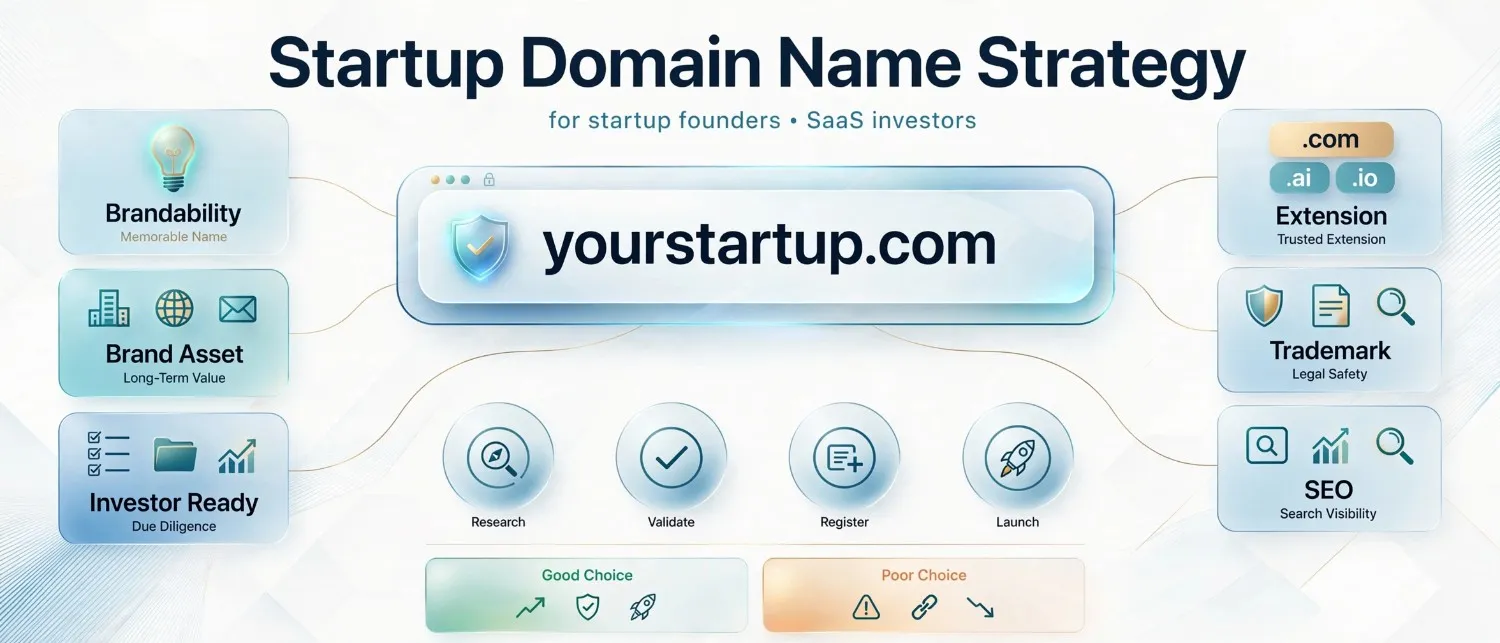
Quick answer: a future-proof startup domain name typically has these traits:
- Short enough to type from memory without spelling it out
- Free of numbers, hyphens, or awkward letter doubling
- Available (or acquirable) on a credible top-level extension, ideally
.com - Clear of existing trademarks in your industry
- Flexible enough to survive a product pivot or new market entry
If a name fails more than one of these tests, it’s worth pausing before you buy.
Why Your Startup Domain Name Strategy Matters More Than You Think
Founders often assume a domain name is a marketing detail. In practice, it touches nearly every function of the business.
It Shapes First Impressions Before Anyone Reads Your Copy

A visitor forms an opinion about your legitimacy within seconds of seeing your URL in a search result or an email signature. Consequently, a name that reads as generic, spammy, or hard to pronounce quietly taxes every marketing channel you run afterward, from paid search to cold outreach.
It Affects Your Cost of Acquisition
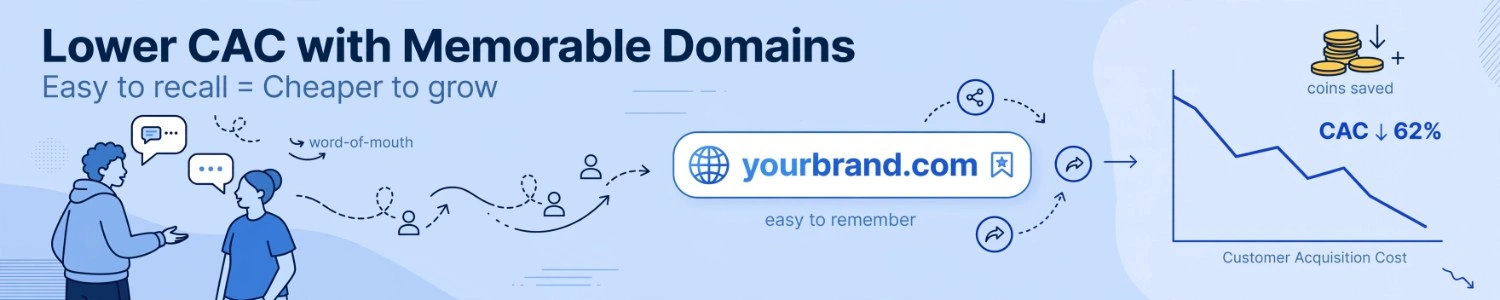
Because a memorable domain is easier to recall and repeat, word-of-mouth referrals convert at a noticeably higher rate. Meanwhile, a forgettable or confusing name forces you to spend more on brand-recall advertising simply to compensate.
It Determines How Much Trust You Inherit

As covered in an in-depth breakdown of how a URL shapes buyer psychology, a domain often functions as a trust signal before a prospective customer ever reads a testimonial or case study. That trust dividend compounds over time, which is exactly why a startup domain name strategy deserves the same rigor as your pricing model or your go-to-market plan.
It Can Become a Liability in Fundraising or M&A

Investors and acquirers run technical and legal diligence on your domain history. An expired-domain purchase with a spam penalty, a name that infringes on a competitor’s trademark, or an extension that reads as low-credibility can all slow down or complicate a deal.
Common Domain Name Mistakes Startups Make (and Regret Later)
Most rebrands aren’t triggered by a change in vision. They’re triggered by a domain decision made too quickly in month one. Here are the recurring patterns.

Mistake 1: Choosing a name that only fits the current product.
A narrow, feature-specific name becomes a liability the moment you expand your offering.
Mistake 2: Ignoring trademark conflicts.
A name that sounds available can still trigger a costly dispute if it overlaps with a registered mark in your category.
Mistake 3: Prioritizing a cheap extension over a credible one.
Obscure extensions can save money upfront but cost trust later, particularly in B2B sales cycles.
Mistake 4: Adding hyphens or numbers to “make it work.”
These additions might solve an availability problem, but they create a lifetime of misdialed URLs and miskeyed emails.
Mistake 5: Skipping a pronunciation test.
If people can’t say your domain out loud with confidence, they won’t refer you by name.
Mistake 6: Underestimating international readability.
A name that works in English can carry an unintended meaning or awkward pronunciation in another market you plan to enter.
Mistake 7: Buying in a rush right before a launch deadline.
Time pressure leads founders to settle, and a settled-for name rarely ages well.
Each of these mistakes is avoidable with a bit of structure, which is where a deliberate step-by-step process helps.
Step-by-Step: Building a Startup Domain Name Strategy That Lasts
Rather than treating domain selection as a single decision, break it into stages. This keeps the process fast without skipping the checks that actually prevent regret.
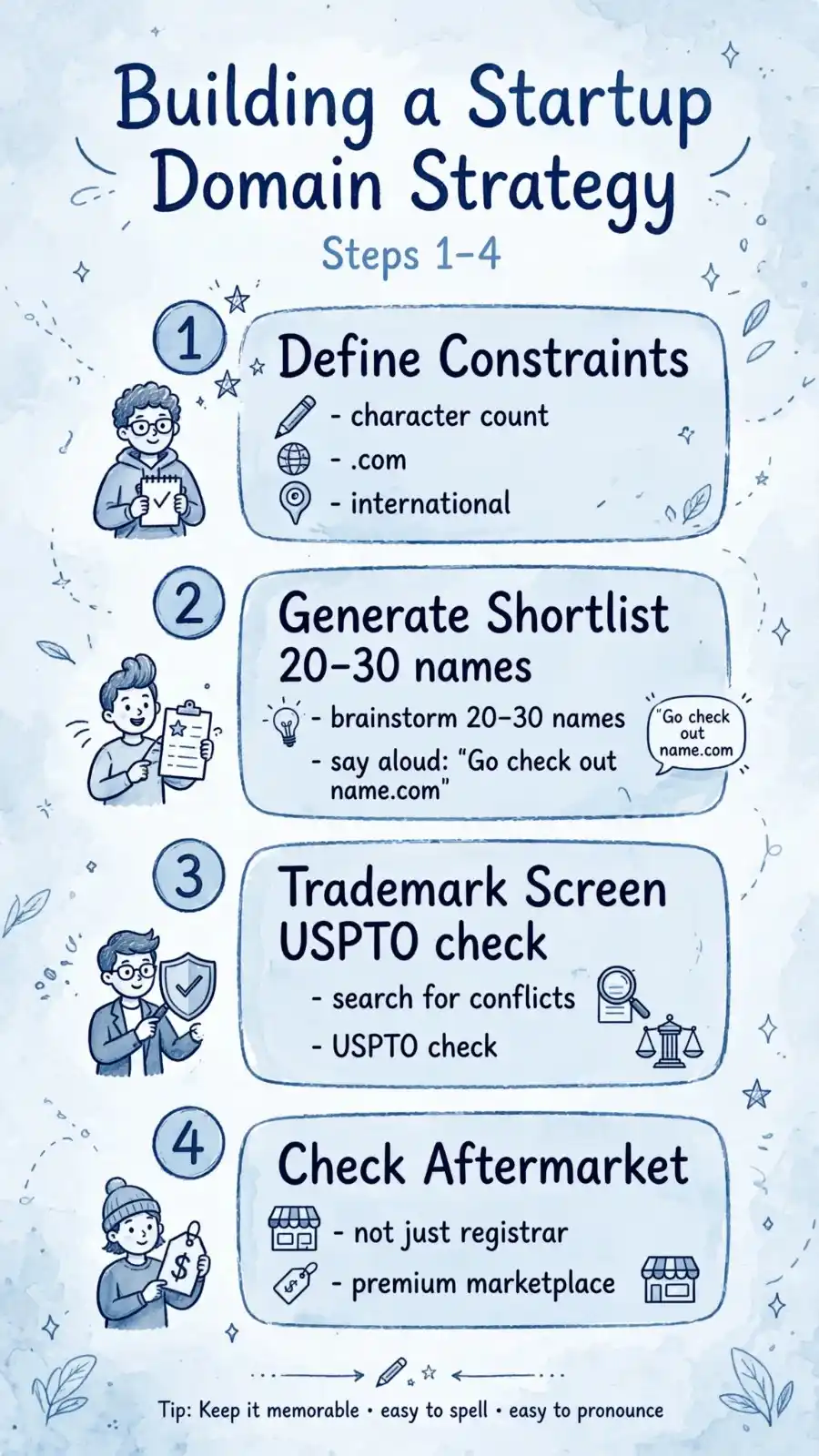
Step 1: Define Your Naming Constraints Before You Brainstorm
Before generating name ideas, write down your non-negotiables: maximum character count, extension preference, whether you’ll accept a compound word, and your international market plans. Constraints speed up brainstorming rather than slowing it down.
Step 2: Generate a Wide Shortlist, Then Narrow by Sound
Aim for 20-30 candidate names initially. Read each one aloud, and say it in a sentence such as “Go check out [name].com.” Names that trip over themselves in speech rarely perform well in word-of-mouth growth.
Step 3: Run a Trademark Screen
Search the name against the trademark database in your primary market and any market you plan to enter within the next two years. In the United States, the USPTO’s Trademark Electronic Search System is the standard first check, and it’s worth confirming an equivalent search for any other jurisdiction where you’ll operate.
Step 4: Check Domain Availability Across the Aftermarket, Not Just Registrars
If your ideal name is already registered, that doesn’t necessarily mean it’s off the table. Many strong startup names live in the aftermarket rather than sitting unclaimed at a standard registrar. This is where working with a curated premium domain marketplace becomes useful, since it surfaces short, brandable, already-registered names that are actually for sale rather than parked indefinitely.
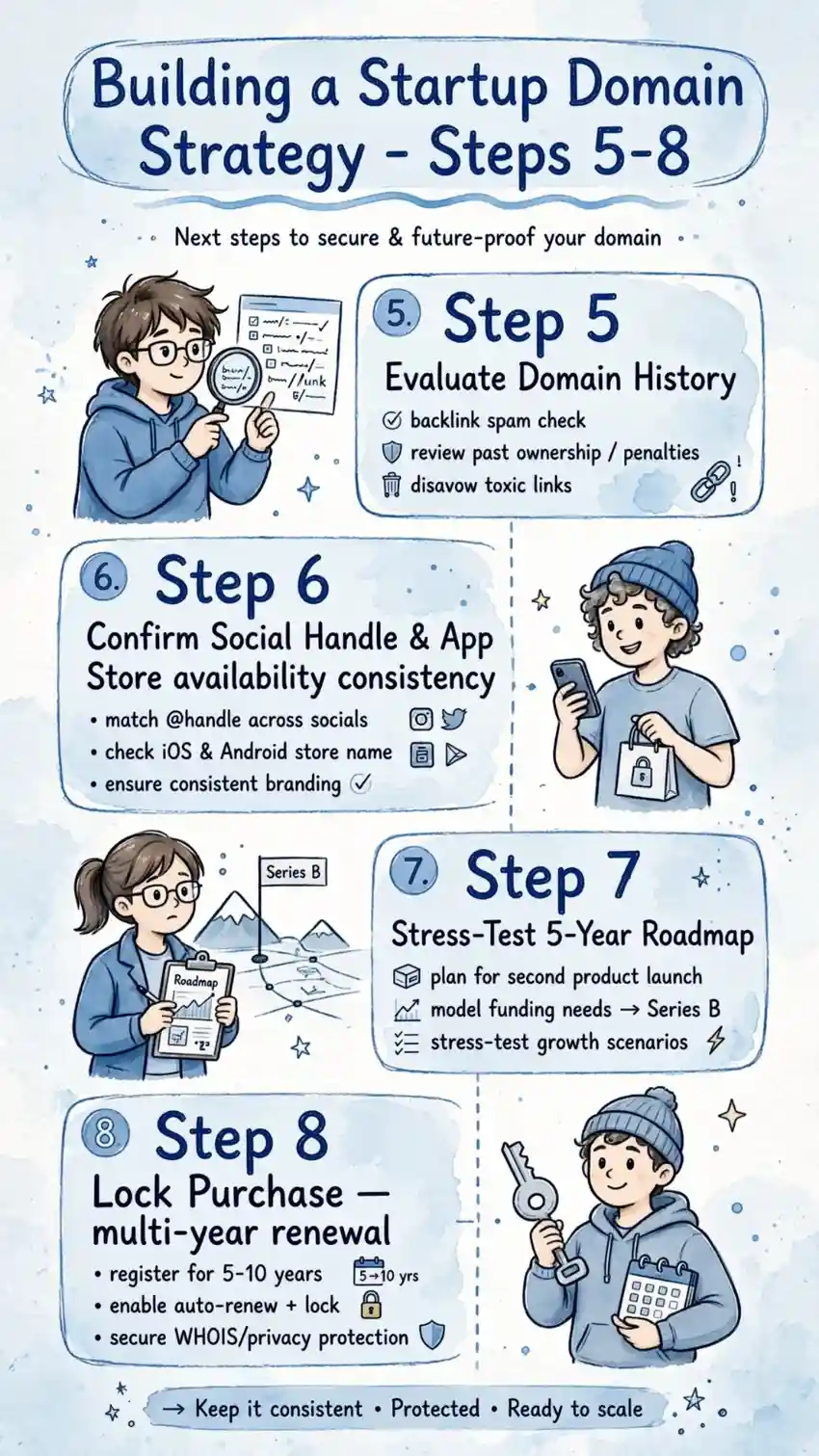
Step 5: Evaluate the Domain’s History
A previously owned domain can carry SEO value or, alternatively, spam baggage. Before buying an aftermarket name, review its backlink profile and prior use. If you’re new to this evaluation process, a beginner’s guide to what works in domain investing covers the due diligence steps worth running before any purchase.
Step 6: Confirm Social Handle and App Store Availability
Even if a domain fits your startup domain name strategy perfectly, check whether matching social handles and app store listings are available. Perfect consistency isn’t always achievable, but close variants are far easier to market than mismatched ones.
Step 7: Stress-Test the Name Against a 5-Year Roadmap
Ask whether the name still makes sense if you add a second product line, raise a Series B, or expand into an adjacent vertical. If the answer is uncertain, favor a broader, brand-first name over a narrow, descriptive one.
Step 8: Lock In the Purchase and Secure Renewal Terms
Once you’ve settled on a name, register it for multiple years upfront where possible. Long registration terms signal stability to search engines and reduce the operational risk of an accidental lapse.
Domain Name Types Compared: .com vs Alternative Extensions
Extension choice is one of the most debated parts of any startup domain name strategy. The table below compares the most common options founders weigh.
| Extension | Perceived Credibility | Typical Cost | Best Fit For |
|---|---|---|---|
| .com | Highest, treated as the default worldwide | Moderate to high for premium names | Most startups, especially B2C and general SaaS |
| .io | High within tech and developer audiences | Moderate | Developer tools, technical products |
| .co | Moderate, seen as a .com alternative | Moderate | Startups locked out of a matching .com |
| .ai | High within AI-specific niches | High, rising with AI category demand | AI-native products and tools |
| Country-code (e.g., .us, .de) | Moderate, strong for local trust | Low to moderate | Regionally focused businesses |
| New gTLDs (e.g., .app, .tech) | Variable, improving over time | Low to moderate | Niche products where .com is unavailable |
As a general rule, .com remains the safest long-term choice for a startup domain name strategy because it carries the least explaining to do. That said, .io has earned genuine credibility in developer-facing categories, and a well-matched niche extension can outperform an awkward .com compromise.
Brandability vs SEO: Finding the Balance
Founders often frame this as a binary choice, but it’s really a spectrum. The comparison below shows where different naming approaches tend to land.
| Naming Approach | Brandability | Built-In SEO Signal | Long-Term Flexibility |
|---|---|---|---|
| Invented word (e.g., “Kavro”) | High | Low initially, builds over time | High |
| Descriptive/keyword name (e.g., “FastInvoiceTool”) | Low to moderate | High initially | Low |
| Compound brand name (e.g., “PayFlowHQ”) | Moderate | Moderate | Moderate |
| Founder or heritage-based name | High if story-driven | Low | High |
A pure keyword-match domain can capture early organic traffic, but it tends to age poorly once you expand beyond the exact phrase in the name. A brandable name takes longer to earn recognition but scales cleanly across products, markets, and eventual acquisitions.
Legal and Trademark Considerations
Trademark exposure is one of the more overlooked pieces of a startup domain name strategy, largely because it’s invisible until it becomes an expensive problem.
- Search both the exact name and close phonetic variants, not just an identical text match.
- Check trademark classes relevant to your specific industry, since the same word can be registered in unrelated categories without conflict.

- Review the domain dispute framework you’d be subject to under the Uniform Domain-Name Dispute-Resolution Policy if a conflict ever arises after purchase.
- Keep a dated record of your first public use of the name, which matters if a dispute over prior rights ever surfaces.
- Consult a trademark attorney before finalizing a name in a competitive or heavily litigated industry, such as fintech or health tech.
Skipping this step to save a few hundred dollars in legal fees is one of the most expensive shortcuts a founder can take, since a forced rebrand later costs far more in lost brand equity than in legal spend today.
Expert Tips for Vetting a Domain Name Before You Buy
Say it over the phone to a stranger. If they need it spelled out, the name has a friction problem.
- Check how it looks in lowercase without spacing. Compound names can accidentally form an awkward or unintended word.
- Search the exact name plus “scam” or “reviews.” This surfaces any negative association already tied to the term.
- Evaluate how the name reads in a URL bar on mobile, since most first impressions now happen on a phone screen.
- Confirm the domain’s expiration and transfer history using WHOIS lookup tools before finalizing any aftermarket purchase.
- Get a second opinion from someone outside your founding team. Founders are often too close to a name to judge it objectively.
When to Consider a Premium Aftermarket Domain
Not every strong name is available through a standard registrar for a standard renewal fee. Many of the shortest, most brandable words were registered years ago and now sit in the aftermarket.

A premium acquisition makes sense when:
- Your ideal name is a single dictionary word or a short, ownable invented word.
- You’ve validated product-market fit and want a name that won’t require a rebrand at scale.
- You’re preparing for a funding round and want your domain to read as established rather than improvised.
- The cost of the domain is small relative to your projected marketing spend over the next few years.
Before buying, it’s worth understanding the factors professional appraisers weigh when pricing a domain, so you can judge whether an asking price is fair, negotiable, or a clear undervaluation.
Case for Buying vs Building From Scratch
A common tension in any startup domain name strategy is whether to invent a brand-new name or acquire an existing, established one.
Building from scratch gives you full ownership over the story behind the name and typically costs less upfront. However, it carries a slower path to memorability, since the brand recognition doesn’t yet exist anywhere.
Buying an established domain shortcuts that recognition problem, particularly if the name already has organic search equity, inbound links, or type-in traffic. The tradeoff is a higher upfront cost and the need for careful due diligence on the domain’s history.
For most early-stage startups without significant funding, a strong invented name registered directly is the pragmatic choice. For startups entering a competitive market or approaching a funding round, a premium aftermarket acquisition often pays for itself through faster trust-building and reduced future rebrand risk.
Frequently Asked Questions
What is the best startup domain name strategy for a company with no funding yet?
Favor a short, invented or lightly descriptive name on a .com extension where possible, and confirm it’s free of trademark conflicts before registering. Avoid overspending on a premium aftermarket name until you’ve validated demand for your product.
Should a startup ever choose a domain extension other than .com?
Yes, particularly in developer-facing or AI-native categories where .io and .ai carry established credibility. The right choice depends on your audience’s expectations more than a universal rule.
How much should a startup budget for a premium domain name?
Budgets vary widely based on the word’s rarity, length, and search demand, ranging from a few hundred dollars for a solid invented name to five or six figures for a short dictionary-word .com. Reviewing appraisal factors before negotiating helps set realistic expectations.
Can a startup change its domain name later without major damage?
It’s possible, but a later rebrand typically costs significant SEO equity, brand recognition, and marketing spend to rebuild. This is exactly why getting the domain name right at the outset is a core part of any serious startup domain name strategy.
Is a hyphenated or numbered domain ever a good idea for a startup?
Generally, no. Hyphens and numbers create friction in verbal referrals, email addresses, and typed recall, all of which quietly erode word-of-mouth growth over time.
Conclusion

A durable startup domain name strategy isn’t a naming exercise you rush through in an afternoon; it’s an early investment decision with a five-year (or longer) payoff horizon. The founders who get this right treat the domain the same way they’d treat a key hire or a first enterprise contract: worth the extra week of diligence to avoid years of regret. If your shortlist keeps coming up short on a standard registrar, built specifically for startups that don’t want to rebrand two years from now.
Pingback: Why .com Is Still Best: 30 Years of Domain Dominance