A domain’s monetary value is determined by a quantifiable intersection of TLD authority, keyword search volume, character length, brandability score, comparable aftermarket sales data, and existing backlink equity. Premium .com domains commanding generic, high-commercial-intent keywords consistently transact in the five-to-seven-figure range on secondary marketplaces, while niche or underdeveloped assets rarely exceed four figures without strategic positioning. Understanding exactly where your domain sits within this valuation matrix is the critical first step before listing it for sale or negotiating a transfer.
If you have ever registered a domain and wondered whether it could be worth something significant, you are not alone. The global domain aftermarket generates hundreds of millions of dollars in annual transaction volume, and many owners are sitting on valuable digital assets without realizing it. This guide breaks down every factor that determines how much your domain is worth – and shows you exactly how to find out.
If you are serious about monetizing your digital assets, exploring a curated portfolio of premium domain names for sale is one of the fastest ways to benchmark your own domain’s market position against actively priced, investment-grade inventory.
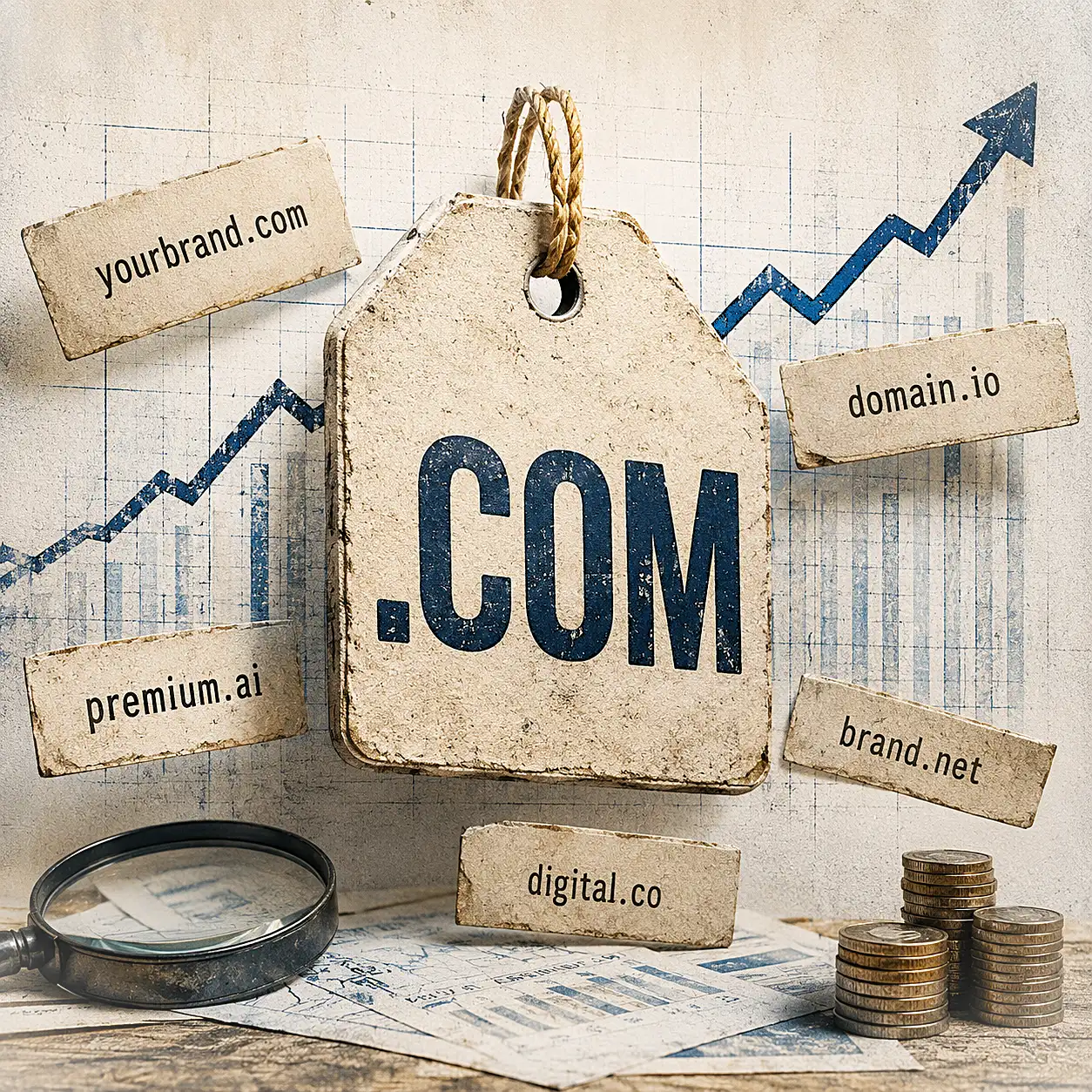
What Does “Domain Value” Actually Mean?
Domain value is not a fixed number. It is a market-determined figure that reflects what a motivated buyer will pay a willing seller under current market conditions. Just like commercial real estate, a domain’s price can shift dramatically based on:
- Changes in industry trends and keyword popularity
- Emerging technologies that make certain terms more relevant
- Shifts in buyer demand for specific TLDs or name styles
- Macroeconomic conditions affecting digital investment appetite
The key insight is this: a domain is worth exactly what someone will pay for it – nothing more, nothing less. Appraisal tools give you an estimate, but the real price is set by the market.
The 8 Core Factors That Determine How Much Your Domain is Worth
1. Top-Level Domain (TLD) Extension
The TLD is one of the single most important valuation factors. The hierarchy, broadly speaking, looks like this:
| TLD | RELATIVE VALUE | NOTES |
|---|---|---|
| .com | Highest | The gold standard; commands premium pricing globally |
| .io | High-medium | Favored by tech and SaaS startups |
| .ai | Rising fast | Surging demand driven by the AI industry boom |
| .co | Medium | Widely recognized .com alternative |
| .net / .org | Medium-low | Established but rarely commands .com prices |
| Country-code TLDs (.uk, .de) | Variable | High value in specific markets only |
| New gTLDs (.shop, .online) | Lower | Generally less liquid on the aftermarket |
A .com domain will almost always appraise significantly higher than an identical name with a different extension. According to NameBio’s historical sales database, the overwhelming majority of six- and seven-figure domain sales involve .com names.
2. Domain Length and Memorability
Shorter domains are exponentially more valuable. The logic is simple: shorter names are easier to remember, type, and brand. Here is a general breakdown:
- 1-4 characters (.com): Extremely rare and extraordinarily valuable – often selling for millions
- 5-6 characters: Premium pricing territory, especially for pronounceable words
- 7-9 characters: Mid-tier; value depends heavily on keyword relevance and brandability
- 10+ characters: Generally lower value unless the name contains powerful commercial keywords
- Hyphens and numbers: Typically reduce value significantly
Single-word generic .com domains such as voice.com (sold for $30 million) represent the pinnacle of domain real estate. Even short, invented names can command strong prices if they are easy to pronounce and spell.
3. Keyword Commercial Value and Search Volume
A domain that contains a keyword with high monthly search volume and strong commercial intent is inherently more attractive to buyers. Businesses specifically seek domains that:
- Match their exact target keyword
- Signal industry authority to search engines
- Reduce the marketing spend needed to build brand recognition
For example, a domain like “InsuranceQuotes.com” carries embedded SEO equity because it aligns with a high-value search term. The higher the cost-per-click (CPC) for a keyword in Google Ads, the more valuable a domain built around that keyword tends to be.
4. Domain Age and Registration History
Older domains often carry more trust signals, particularly if they have been actively used in the past. Factors to examine include:
- Domain age: Older registration dates can indicate established credibility
- Previous content: Was the domain used for a legitimate website?
- Backlink profile: Does it retain authority links pointing to it?
- No penalty history: Was it ever penalized by Google for spam or manipulation?
You can investigate a domain’s history using the Wayback Machine at web.archive.org to review archived versions of any previously hosted website.
5. Existing Traffic and Backlink Equity
A domain that currently receives organic or type-in traffic is worth substantially more than a purely speculative asset. Buyers pay for:
- Direct navigation traffic: Users typing the domain directly into the browser
- Residual organic traffic: Traffic from legacy search rankings
- Backlink portfolio: Quality inbound links that pass domain authority
- Domain Rating (DR) or Domain Authority (DA): Third-party SEO metrics that indicate link equity
A domain with even modest but consistent traffic can justify a significantly higher asking price than a comparable name with no existing traffic at all.
6. Brandability and Linguistic Quality
Not every valuable domain contains a dictionary word. Highly brandable invented names – think Google, Spotify, or Zappos – command premium prices because they are:
- Unique and trademarkable
- Easy to say and spell
- Free from negative connotations in major languages
- Versatile across product categories
Brandability is one of the more subjective valuation factors, but experienced buyers recognize it immediately. A name that “sounds right” for a tech company, a fintech startup, or a consumer brand carries real premium value beyond its keyword content.
7. Comparable Sales (Comps)
The most reliable way to estimate what your domain is worth is to look at what similar domains have sold for recently. This is the same approach used in real estate valuation.
Key resources for researching comparable sales include:
- NameBio: Tracks publicly reported domain sales with searchable filters
- DN Journal: Weekly sales reports on significant transactions
- Sedo Marketplace: Public listing prices and completed auction results
- GoDaddy Auctions: Historical data on aftermarket transactions
When searching for comps, look for domains with similar length, keyword type, TLD, and industry category. A tight cluster of comparable sales gives you a defensible pricing anchor.
8. Market Trends and Industry Demand
Domain values fluctuate with technology cycles. The explosion of AI in 2023 and 2024, for instance, drove .ai domain prices to record levels. Similarly:
- The crypto boom inflated values for blockchain-related domains
- The DeFi and NFT wave created temporary spikes in related terms
- Remote work trends increased demand for collaboration and productivity keywords
- The growing importance of personal branding has elevated value for name-based domains
Staying aware of current industry trends helps you time a domain sale strategically, maximizing what you receive at exit.
Domain Value Ranges: A Practical Reference Table
| DOMAIN CATEGORY | TYPICAL MARKET VALUE RANGE | KEY DRIVERS |
|---|---|---|
| Ultra-premium generic .com | $1M+ | Single word, maximum commercial intent |
| Premium keyword .com | $50,000 – $999,999 | 2-3 word exact-match commercial terms |
| Mid-market .com | $5,000 – $49,999 | Brandable or niche keyword domains |
| Entry-level aftermarket | $500 – $4,999 | Decent name, limited demand |
| Low-value speculative | Under $500 | Long, hyphenated, or low-demand names |
| Alternative TLDs (.io, .ai) | Wide variance | Comparable keywords, less than .com |
How to Find Out What Your Domain Is Worth: Step-by-Step
Here is a practical process for generating a reliable valuation estimate:
Step 1: Run an Automated Appraisal Start with one or more of the following free or freemium tools:
- GoDaddy Domain Appraisal – Uses machine learning and real sales data from 20+ years of transactions
- Estibot – Analyzes keyword data, search volume, CPC, and comparable sales
- Sedo Free Valuation – Incorporates their own marketplace transaction history
These tools provide a quick baseline, but treat them as a starting point, not a final answer.
Step 2: Research Comparable Sales Visit NameBio.com and search for domains that match your name’s profile: same TLD, similar length, comparable keyword niche. Note the median and upper price points for recent transactions.
Step 3: Check Keyword Data Use Google Keyword Planner or a third-party SEO tool to determine the monthly search volume and CPC for keywords embedded in your domain name. High search volume combined with high CPC signals strong commercial value.
Step 4: Audit the Backlink Profile Use a tool like Ahrefs, SEMrush, or Moz to check if the domain has any residual link equity. Even a modest backlink profile from legitimate sites can meaningfully increase your asking price.
Step 5: Evaluate Brandability Objectively Say the domain name out loud. Is it easy to pronounce? Easy to spell? Does it sound credible for a modern business? Ask others for an honest first impression. Strong brandability adds a premium that algorithms rarely capture accurately.
Step 6: Cross-Check Listing Prices Browse active listings on Sedo, Afternic, or similar marketplaces for comparable domains currently for sale. Listing prices are not the same as sale prices, but they establish the ceiling of buyer expectations in that category.
Step 7: Consult a Domain Broker (for High-Value Names) If preliminary research suggests your domain may be worth $10,000 or more, a professional domain broker can conduct a thorough market analysis and connect you with qualified buyers. Brokers typically work on commission, so the fee is tied to a successful sale.
Common Mistakes That Lead to Inaccurate Domain Valuations
Many domain owners make the same errors when trying to determine what their domain is worth. Avoiding these pitfalls will save you time and money:
- Trusting a single appraisal tool blindly: Algorithms vary widely in accuracy and methodology. Always cross-reference multiple sources.
- Anchoring to purchase price: What you paid for a domain has no bearing on its current market value.
- Overvaluing based on personal attachment: You registered it, you love it – but buyers do not share that sentiment.
- Ignoring comparable sales data: The aftermarket is the only true price discovery mechanism for domains.
- Setting a price based on revenue potential alone: Buyers discount heavily for speculative future earnings.
- Neglecting to check trademark conflicts: A domain that conflicts with a registered trademark has significant legal and value risk.
- Undervaluing because an appraisal tool returns a low figure: Automated tools frequently undervalue brandable, short, or niche-specific names.
How Domain Brokers and Marketplaces Value Your Asset
When you submit a domain to a professional broker or marketplace, they typically apply a multi-dimensional appraisal framework:
- Comparable sales analysis – Recent transactions for similar names
- Keyword traffic and CPC analysis – Commercial intent embedded in the name
- TLD premium calculation – Extension-based multipliers
- Backlink and traffic audit – Residual digital equity
- Buyer pool assessment – How many potential buyers exist for this specific name?
- Timing and market conditions – Is the underlying niche growing or declining?
Experienced brokers also factor in intangibles: Is the name defensible as a trademark? Does it work across different cultures and languages? These considerations rarely appear in automated tools but are critical to real-world pricing.
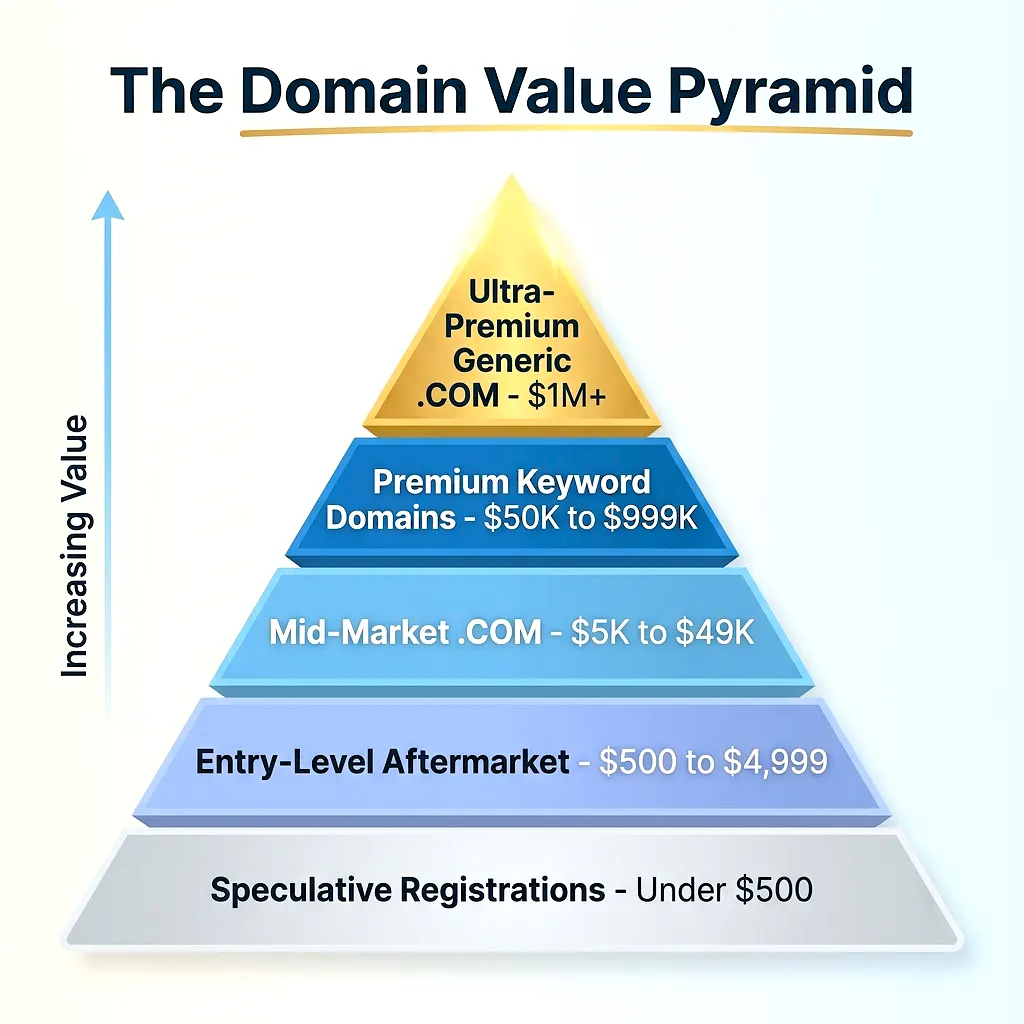
The Domain Valuation Pyramid
- Top tier (apex): Ultra-premium – Generic single-word .com domains ($1M+)
- Second tier: Premium keyword domains, short brandable names ($50K-$999K)
- Third tier: Mid-market .com with strong keyword relevance ($5K-$49K)
- Fourth tier: Entry aftermarket – decent brandable names with limited traffic ($500-$4,999)
- Base: Speculative registrations with no keyword value or traffic (<$500)
Domain value follows a power-law distribution: the top 1% of names command the vast majority of aftermarket transaction volume.”
Expert Tips for Maximizing Your Domain’s Value Before You Sell
Before listing your domain for sale, consider these professional-level strategies to strengthen your asking price:
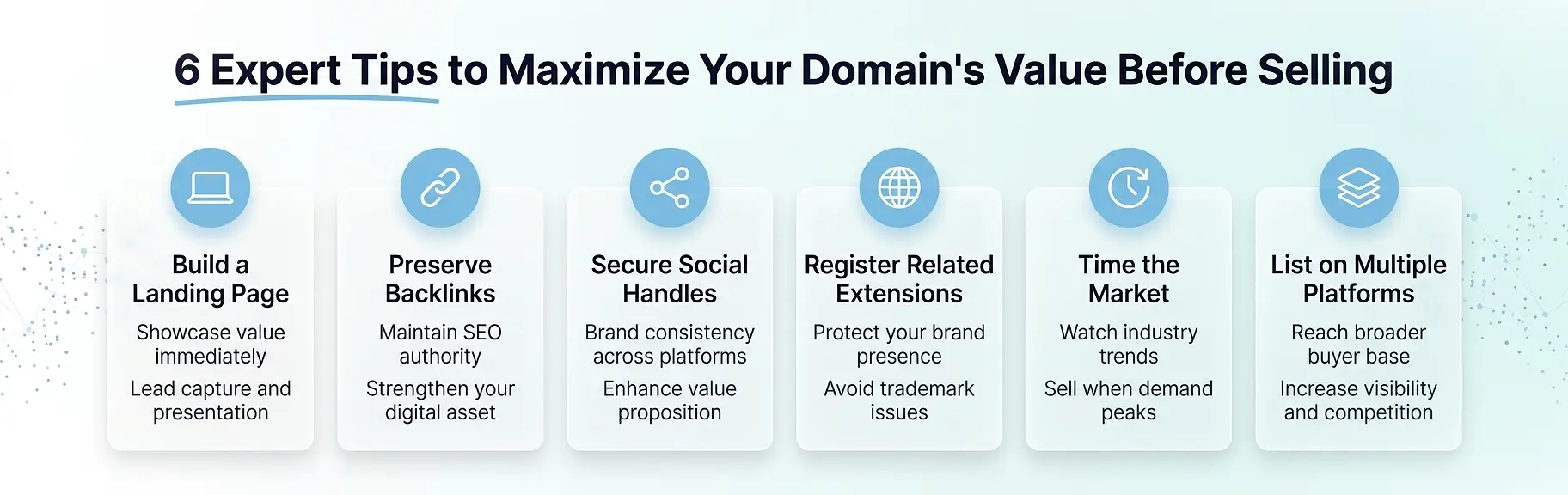
- Develop a landing page: Even a simple one-page website signals legitimate use and can attract type-in traffic
- Build or preserve backlinks: Inbound links increase perceived domain authority
- Secure social media handles: Buyers pay more when the matching username on X, Instagram, and LinkedIn is available
- Register related extensions: Owning the .com, .co, and .io variants of a name can support a bundled sale at a premium
- Time the market: List when your domain’s industry is experiencing strong growth momentum
- Set a realistic asking price: Overpriced domains sit unsold for years; underpriced assets leave money on the table
- Use multiple platforms: List simultaneously on Afternic, Sedo, and premium marketplaces to maximize buyer exposure
Frequently Asked Questions
How much is my domain worth if I registered it recently? A newly registered domain with no traffic, no backlinks, and no keyword significance is typically worth the cost of registration – between $10 and $20. However, if you registered a highly brandable name or a keyword with strong commercial intent, its value could be substantially higher from day one.
Can I find out how much my domain is worth for free? Yes. Tools like GoDaddy Domain Appraisal, Estibot, and Sedo’s free valuation service provide no-cost estimates. These automated tools are a useful starting point but should be supplemented with comparable sales research for a realistic market picture.
What is the most important factor in determining how much a domain is worth? The TLD extension (.com vs. everything else) and the commercial intent of embedded keywords are generally the two most impactful factors. Short, memorable .com domains with high-value keywords consistently attract the strongest buyer demand and highest prices.
How long does it take to sell a domain once I know its value? Timelines vary significantly. Highly desirable domains with the right buyer can close in days. Average aftermarket inventory can take months to years to find the right buyer at the right price. Active promotion across multiple platforms reduces average time-to-sale.
Does a domain’s age affect how much it is worth? Age can be a positive factor, particularly if the domain has an established backlink profile or historical traffic data. However, age alone does not drive value – a 20-year-old domain with no keyword relevance and no traffic history is not automatically more valuable than a newly registered short .com.
Should I use a broker to sell my domain? For domains you believe are worth $10,000 or more, a professional broker is generally worth the commission. Brokers provide access to qualified buyers, handle negotiation, and manage the legal and technical aspects of the transfer. For lower-value names, self-service marketplaces are more cost-effective.
What is the difference between an appraisal and a domain’s actual market value? An appraisal is an algorithmic estimate based on data inputs. Actual market value is the price a specific buyer agrees to pay under current conditions. The two can differ significantly – in either direction. This is why comparable sales data is more reliable than any single automated appraisal for pricing decisions.
Understanding Your Domain’s True Market Value
So, how much is your domain worth? The honest answer is that it depends on a combination of objective data points – TLD, length, keyword value, traffic, and comparable sales – and subjective market factors like brandability, buyer pool depth, and timing. No single appraisal tool can give you a definitive answer, but a systematic approach combining automated estimates, comparable sales research, and professional broker input gives you the most accurate picture.

The domain aftermarket is a real, liquid asset class where AI.com reportedly transacted for $70 million and premium generic names routinely command six and seven-figure prices. Even mid-tier assets in the right niche can deliver returns that far exceed the initial registration cost. The key is understanding how the market values what you own – and positioning it accordingly.
Ready to understand where your domain sits in the market? Start by browsing premium domain names for sale at OENOR to benchmark your asset against professionally priced, investment-grade inventory and connect with buyers who understand the real value of premium digital real estate.